Wednesday, April 30, 2008

Peptides provide fatal blow for cancer cells

21 April 2008

Peptide nanostructures that punch holes in cancer cells are 'the first step towards efficient nanochemotherapeutics,' say chemists in Canada.

Normand Voyer and colleagues at the University of Laval in Québec have designed a series of modified peptide nanostructures that can puncture cancer cell membranes, leading to the cells' death.

"In the past decade, cancer cell resistance to chemotherapeutic agents has led to increased cancer deaths"
The team explains that in the past decade, cancer cell resistance to chemotherapeutic agents has led to increased cancer deaths. 'We believe that nanochemotherapeutics can overcome this problem due to the particular properties of nanometre-sized compounds,' says Voyer.

Basing their structures on a membrane-disrupting peptide they had made previously, the researchers engineered analogues that would be selective for cancer cells. The engineered peptides are inactive until they reach cancer cell surfaces where they convert into an active cell membrane disruption agent. Since the enzyme that activates the peptides is over-expressed in prostate cancer cells, normal cells do not activate the peptide to the same extent, leading to the peptides' selectivity.

Untreated cancer cells and cancer cells treated with peptide nanostructures

When cancer cells (left) are treated with peptide nanostructures their cell membranes are destroyed (right)

Vincent Rotello, an expert in the supramolecular chemistry of biological and materials systems at the University of Massachusetts, Amherst, US, is enthusiastic about the findings. 'While enzymatic activation has been used before for therapeutics,' he says, 'this peptide-based scaffold has great promise due to the modular nature of its construction.' This is because the amino acid building blocks used to assemble the peptides can be readily varied, which provides 'incredible control over the structure and dynamics of the eventual therapeutics,' Rotello adds.

Voyer explains that the work 'illustrates chemists' abilities to design novel nanometre-sized molecular architectures from scratch to address highly challenging problems.' Future efforts will be geared towards 'determining the mechanism of action of this new class of antitumour agents,' he adds.

Kathleen Too

Link to journal article: Nanoscale tools to selectively destroy cancer cells

Pierre-Luc Boudreault, Mathieu Arseneault, François Otis and Normand Voyer, Chem. Commun., 2008, 2118
DOI: 10.1039/b800528a

Source

Nanodiamonds gain low-cost sparkle

28 April 2008

Fluorescent nanodiamonds can now be made 100 times more cheaply than before, thanks to work by chemists in Taiwan. The new process should provide easier access to the tiny diamonds, which could have future applications in medical imaging and cancer therapy.

Nanodiamonds are made by detonating two explosive compounds, TNT and RDX, and then collecting the resulting soot - which contains diamonds approximately 4nm in size. But to make the diamonds fluoresce they have to be exposed to a high-energy electron beam from a van de Graaff accelerator, then heated to 800°C - a costly procedure.

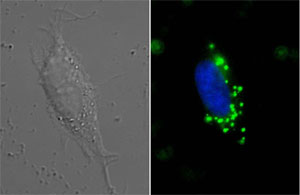
Internalization of green fluorescent diamonds by a cancer cell

Image showing the internalization of green fluorescent diamonds by a cancer cell

© Fann et al

Instead, the Taiwanese researchers used a purpose-built machine to bombard nanodiamonds with high-energy helium ions. This causes defects to form in the structure of the diamonds so that they fluoresce when they are hit by laser light.

'Our high-fluence medium-energy (40 keV) helium ion beam can be operated safely and routinely in ordinary laboratories,' says Huan-Cheng Chang, who led the team with Wunshain Fann at the National Taiwan University. The team have already started selling their nanodiamonds - charging around £150 for 10mg - a hundredth of the cost of those made by conventional methods.

In the same way that quantum dots or fluorescent beads are used to illuminate tumours, the researchers envisage that nanodiamonds could be connected to tumour-seeking drugs or antibodies to function as beacons.

'Carbon-based nanodiamonds possess several properties that make them very amenable to biological studies,' says Dean Ho at Northwestern University, Illinois, who was the first to show that nanodiamond clusters could be used to deliver chemotherapy drugs to cancer cells. 'They are soluble in water and have very good biocompatibility: they cause very little inflammation in the body.'

'But work still needs be done to evaluate toxicity and clearance time - how long the diamonds remain in the body - before clinical trials can begin,' Ho told Chemistry World.

Lidija Siller of the Nanoscale Science and Nanotechnology Group at Newcastle University, UK, says that other luminous nanoparticles available for biological applications are more toxic to cells. 'This work represents a step forward in fluorescent nanodiamond production and should stimulate research to further improve separation, size selection, mass production and applications of this material.'

Lewis Brindley

References

W Fann et al, Nat. Nanotech., 2008, DOI:10.1038/nnano.2008.99

Source

Supplementary info

NewScientist Tech article on this same subject

Nanotechnology breakthrough attracts global optics giant

Mistakes!

Kinda reminds me of NNVC's - you know - surround and throttle the virus to death - no API (Active Pharmaceutical Ingredient) needed. Serendipity=Mistake!:

April 29, 2008

Nanotechnology breakthrough attracts global optics giant

(The Salem News (Salem, Mass.) Via Acquire Media NewsEdge) Apr. 29--PEABODY --

Like many breakthroughs, research scientist Bill Ward's was a mistake.

It's a mistake that caught the attention of global optics manufacturer Carl Zeiss SMT of Germany, which celebrated the grand opening of its $9 million, 53,000-square-foot Nano Solutions Center last week in Peabody's Centennial Park.

Ward, who helped found a Peabody nanotechnology startup called ALIS, had nearly given up on a decades-old project to channel helium ions toward the smallest of structures as a way to create high-resolution images of them.

But it wasn't until Ward threw a switch on his prototype that the method worked, said his business partner Nick Economou. The research scientist spent the next six months unraveling his mistake to understand why it worked when other methods hadn't.

"Basically, it was a mistake that led to the breakthrough," Economou said.

Carl Zeiss SMT believed so strongly in Ward's design that it decided to headquarter its North American operation in Peabody, where the research scientist conducted his work. The company also named Economou its senior vice president and Ward its chief technical officer.

The German company already offered an array of electron- and ion-beam microscopes. The acquisition of ALIS added a new product, the company's ORION or Ward's helium-ion microscope. The device offers the clearest pictures of the atomic world.

Carl Zeiss was one of a handful of companies courting ALIS after Ward made his microscope work. In fact, Oregon-based nanotech FEI Co., from which ALIS had spun off, also sought to reacquire it.

Ultimately, ALIS and its 36 scientists and employees went with the offer from Carl Zeiss SMT.

"We picked Zeiss and they picked us," Economou said.

Frank Averdung, president of Carl Zeiss SMT, said the company's search to house its North American division ended in Peabody because of its access to a highly skilled work force and proximity to research universities.

"The acquisition of ALIS helped us to make the decision to move here," Averdung said.

Zeiss board member Dirk Stenkamp said ALIS's "revolutionary technology has the potential to really drive us into the next century."

The North American branch currently employs 70, with jobs ranging from engineering to manufacturing to science. But the operation is expected to grow to 200 in Peabody. The business is part of an emerging local niche dubbed the "Ion Alley," Economou said.

Carl Zeiss' helium-ion microscope will have applications in biology, helping scientists better visualize DNA, and in the semiconductor industry.

"We're going to enable them to see what they're actually manufacturing," Economou said.

How small is a nanometer?

The helium-ion microscope can provide clear imagery at the atomic level in nanometers, but exactly how small is a nanometer? It's defined as one-billionth of a meter.

Some other ways to understand just how small a nanometer is:

r A sheet of paper is about 100,000 nanometers thick.

r Blond hair is probably 15,000 to 50,000 nanometers in diameter, but black hair is likely to be between 50,000 and 180,000 nanometers.

r There are 25.4 million nanometers in an inch.

r A nanometer is a millionth of a millimeter.

Source: Federally funded National Nanotechnology Initiative

http://ipcommunications.tmcnet.com/news/2008/04/29/3415896.htm

An Electrifying Startup

A new lithium-ion battery from A123 Systems could help electric cars and hybrids come to dominate the roads.

By Kevin Bullis


Side Impact: A battery designed by A123 Systems for GM’s Volt electric vehicle can survive a crushing safety test. The high-velocity impact could have caused other lithium-ion batteries to overheat and catch fire.
Credit: Porter Gifford

It is the quickest electric motorcycle in the world. On a popular YouTube video, the black dragster cycle nearly disappears in a cloud of smoke as the driver does a "burn-out," spinning the back wheel to heat it up. As the smoke drifts away, the driver settles into position and hits a switch, and the bike surges forward, accelerating to 60 miles per hour in less than a second. Seven seconds later it crosses the quarter-mile mark at 168 miles per hour--quick enough to compete with gas-powered dragsters.

What powers the "Killacycle" is a novel lithium-ion battery developed by A123 Systems, a startup in Watertown, MA--one of a handful of companies working on similar technology. The company's batteries store more than twice as much energy as nickel-metal hydride batteries, the type used in today's hybrid cars, while delivering the bursts of power necessary for high performance. A radically modified version of the lithium-ion batteries used in portable electronics, the technology could jump-start the long-sputtering electric-vehicle market, which today represents a tiny fraction of 1 percent of vehicle sales in the United States. A123's batteries in particular have attracted the interest of General Motors, which is testing them as a way to power the Volt, an electric car with a gasoline generator; the vehicle is expected to go into mass production as early as 2010.

In the past, automakers have blamed electric vehicles' poor sales on their lead-acid or nickel-metal hydride batteries, which were so heavy that they limited the vehicles' range and so bulky that they took up trunk space. While conventional lithium-ion batteries are much lighter and more compact, they're not cost effective for electric vehicles. That's partly because they use lithium cobalt oxide electrodes, which can be unstable: batteries based on them wear out after a couple of years and can burst into flame if punctured, crushed, overcharged, or overheated. Some auto­makers have tried to engineer their way around these problems, but the results have been expensive.

A123's batteries could finally make lithium-ion technology practical for the auto industry. Instead of cobalt oxide, they use an electrode material made from nanoparticles of lithium iron phosphate modified with trace metals. The resulting batteries are unlikely to catch fire, even if crushed in an accident. They are also much hardier than conventional lithium-ion batteries: A123 predicts that they will last longer than the typical lifetime of a car.

The battery's promise has made A123 one of the best-funded technology startups in the country, with $148 million in venture capital investments so far. With the funding, A123 has been pursuing an ambitious business plan that calls for it to do everything from perfecting the material to manufacturing batteries and selling them to customers in the auto and power-tool industries.

The A123 batteries for GM's Volt store enough energy for 40 miles of driving, enough to cover daily commutes. (On longer trips, the small gasoline engine would kick in to recharge the battery, extending the range to more than 400 miles.) GM plans to sell the vehicles for around $30,000 to $35,000; the company thinks it can sell hundreds of thousands at that price in the first several years, and J. D. Power and Associates estimates that GM will sell nearly 300,000 by 2014.

Materials Matter
In early 2001, a 26-year-old Venezuelan entrepreneur named Ric Fulop walked into the office of Yet-Ming Chiang, a professor of materials science at MIT, without an appointment. "He just showed up and knocked on the door," recalls Chiang. Fulop, who had already founded three venture­-backed companies, wanted help starting a battery company, and he knew that Chiang was conducting battery research involving nanotechnology. Chiang himself had cofounded a successful startup in the late 1980s, but he spent most of his time researching nanotechnology and the chemistry of advanced ceramics.

By the fall, Fulop and Chiang, along with Bart Riley, an engineer Chiang knew from his previous venture, had cofounded A123 Systems. The plan was to commercialize one of Chiang's more radical ideas: materials that, when stirred together, would spontaneously assemble to form a working battery. The process promised to multiply energy storage capacity while lowering manufacturing costs.

Chiang's big idea turned out to be a hit with investors. By the end of 2001, a first round of funding had brought in $8.3 million from various venture capital firms. Motorola and Qualcomm, intrigued by the prospect of better batteries for portable electronics, soon added $4 million. But it quickly became clear that a commercial self-assembling battery was years away from reality. The technology "was still pretty rudimentary," Chiang says.

In early 2002, however, Chiang made a surprising discovery that would completely change the company's direction. He had begun to work with lithium iron phosphate, which is nontoxic, safe, and inexpensive, unlike the materials used in other lithium-ion batteries. But it appeared to have some serious drawbacks. It stores less energy than lithium cobalt oxide, the electrode material in conventional lithium-ion batteries, so it seemed unsuitable for use in portable electronics, where energy storage is paramount. Also, it charges and discharges slowly, ruling out its use in high-power applications such as hybrid electric vehicles; even for fully electric cars, which use many more battery cells than hybrids, the material couldn't deliver enough power.

So Chiang started to modify it by adding trace amounts of metals. Soon the material was discharging power at relatively high rates. In mid-2002, he flew to Monterey, CA, to present his findings at a conference. While he was there, a graduate student back at MIT continued running tests. By the time ­Chiang was scheduled to talk, the material was performing at rates four times those he had come to announce. "At that point, we knew we had something special," he says.

Eventually, Chiang would demonstrate that the material could deliver bursts of electricity at 10 times the rate of those used in conventional lithium-ion batteries. After studying the high-­performing material in detail, he determined that it owed its power both to the size of the particles he'd used (less than 100 nanometers) and to the addition of the extra metals. The combination of those factors, he says, causes a fundamental difference in the way the atoms that make up the material rearrange themselves when they receive and release a charge.

Packed Up: A123’s battery cells (above) have been integrated into a T-shaped pack engineered by the German firm Continental.
Credit: Porter Gifford

In all lithium-ion batteries, electricity is generated when lithium ions shuttle between two electrodes while electrons travel through an external circuit. In Chiang's early experiments with lithium iron phosphate, the parts of the material that contained lithium would separate from those that didn't as the lithium ions moved in and out of an electrode. That changed the crystalline structure of the material, and its performance deteriorated. But, ­Chiang discovered, when the particles of lithium iron phosphate are small enough--and the electrode has been modified, or "doped," through the addition of other metals--the material's crystalline structure changes far less. As a result, the lithium ions can move in and out faster, without degrading the material. Altogether, Chiang found that the modified material charged and discharged faster than ordinary lithium iron phosphate, and it lasted longer, too.

Extraordinary though the new battery material seemed to be, ­Chiang realized immediately that it wasn't ideal for portable electronics. There didn't seem to be a ready market for light, compact batteries that delivered large bursts of power. Hybrid vehicles, a natural fit, were only beginning to appear on the market. What Chiang didn't know was that a major power-tool company was working quietly on a new generation of cordless tools, and it was having trouble finding a battery that would meet its needs.

Powerful Start
In 2003, representatives of Black and Decker met with Fulop and A123's CEO, Dave Vieau, and told them that they wanted to make cordless power tools that would perform better than tools plugged in to the wall. A123's material seemed like a perfect fit. In short bursts, it can deliver more power than a household circuit. And it had other features that would be attractive on a construction site. It could be recharged quickly (to 80 percent of capacity in 12 minutes or less), and unlike batteries made with lithium cobalt oxide, it could survive harsh treatment without catching fire.

That, at least, was the theory. When Fulop and Vieau first met with Black and Decker, they had only a model of a battery cell, half a gram of material, and a PowerPoint presentation. What Black and Decker needed was a company that could produce millions of batteries. "There was a lot of emphasis on the material, but what we had to learn how to do is to engineer the complete cell," Chiang says.

Within a year of signing its initial agreement with Black and Decker, however, A123 had produced a commercially feasible battery. By November 2005, its first products were coming off assembly lines in Asia. In less than three years, the company went from building a demonstration battery the size of a coin to building 50-meter-long coating machines and 28,000-square-meter factories run by hundreds of employees. By 2006, customers were buying its batteries in a new line of professional tools sold by Black and Decker. In short order, A123 was manufacturing batteries at the rate of millions a year.

Charging Up Cars
Meanwhile, GM was rethinking its technology strategy as Toyota began to dominate the hybrid-vehicle business. A hybrid uses a battery only part of the time, relying on a gasoline engine for much of its power. GM decided to develop a car that would allow its customers to stop using gasoline entirely for most daily driving. But to pull it off, the automaker needed a high-performance, reliable battery. And for that it turned to A123.

GM knew that it wanted to use lithium-ion batteries because of their storage capacity, says Denise Gray, GM's director of energy storage systems. But it also knew that existing technology wouldn't do the trick. Though a lithium-ion laptop battery might survive 500 complete charge-and-discharge cycles before its capacity fades, no car owner wants to buy a new battery every 18 months. According to A123's projections, however, its batteries should be able to deliver more than 15 years' worth of daily charges. And in addition to being safer than other lithium-ion batteries, A123's operate at a lower temperature, which makes it simpler to pack hundreds of them together into a large battery pack, Gray says.

Where A123's power-tool batteries are cylindrical, the battery it developed for the Volt is flat, to save space and more efficiently dissipate heat. The cells have been assembled into complete battery packs, which are T-shaped and nearly two meters long. This spring, the batteries will be bolted into vehicle prototypes for road testing. And later this year, A123 plans to increase production of the batteries to meet anticipated demand. The first cars powered by A123 technology could be rolling off assembly lines in 2010. (GM is also testing batteries from another company, and may use batteries from either or both companies.)

If the Volt is popular, electric cars could finally start to take off--and that could reduce greenhouse-gas emissions and petroleum consumption. A recent study by the Electric Power Research Institute and the Natural Resources Defense Council suggests that electric vehicles similar to GM's car could eliminate billions of tons of greenhouse-gas emissions between 2010 and 2050. A study by General Electric indicates that if half the vehicles on the road in 2030 are electric-powered, petroleum consumption in the United States will shrink by six million barrels a day.

And batteries like A123's could have repercussions far beyond the Volt. Even cars with internal-combustion engines are being engineered to rely more on electricity: the simplest examples involve batteries recharged by souped-up alternators that would allow a car to shut off its engine when it approaches a stoplight and restart when the driver hits the accelerator. In conventional hybrids, versions of A123's batteries can deliver as much power as nickel-metal hydride batteries at one-fifth the weight. The new batteries could also benefit plug-in hybrids, which can be recharged from a standard electrical outlet. Indeed, A123's batteries may be used in a plug-in version of the Saturn Vue hybrid SUV that's due out in 2010.

Whatever their design, future cars will be likely to rely much more on electricity. "We're not there yet," Chiang says. "There aren't Volts all over the place. But the potential to have a big impact, both on the oil supply issue and greenhouse gases--I didn't imagine that we'd be able to do that. Certainly not when I started working on batteries."

Kevin Bullis is TR's Nanotechnology and Materials science Editor.

Source


Tuesday, April 29, 2008

Silver Nanoparticles May Be Killing Beneficial Bacteria In Wastewater Treatment

ScienceDaily (Apr. 30, 2008) — Too much of a good thing could be harmful to the environment. For years, scientists have known about silver's ability to kill harmful bacteria and, recently, have used this knowledge to create consumer products containing silver nanoparticles. Now, a University of Missouri researcher has found that silver nanoparticles also may destroy benign bacteria that are used to remove ammonia from wastewater treatment systems.

Several products containing silver nanoparticles already are on the market, including socks containing silver nanoparticles designed to inhibit odor-causing bacteria and high-tech, energy-efficient washing machines that disinfect clothes by generating the tiny particles. The positive effects of that technology may be overshadowed by the potential negative environmental impact.

"Because of the increasing use of silver nanoparticles in consumer products, the risk that this material will be released into sewage lines, wastewater treatment facilities, and, eventually, to rivers, streams and lakes is of concern," said Zhiqiang Hu, assistant professor of civil and environmental engineering in MU's College of Engineering. "We found that silver nanoparticles are extremely toxic. The nanoparticles destroy the benign species of bacteria that are used for wastewater treatment. It basically halts the reproduction activity of the good bacteria."

Hu said silver nanoparticles generate more unique chemicals, known as highly reactive oxygen species, than do larger forms of silver. These oxygen species chemicals likely inhibit bacterial growth. For example, the use of wastewater treatment "sludge" as land-application fertilizer is a common practice, according to Hu. If high levels of silver nanoparticles are present in the sludge, soil used to grow food crops may be harmed.

Hu is launching a second study to determine the levels at which the presence of silver nanoparticles become toxic. He will determine how silver nanoparticles affect wastewater treatment processes by introducing nanomaterial into wastewater and sludge. He will then measure microbial growth to determine the nanosilver levels that harm wastewater treatment and sludge digestion.

The Water Environment Research Foundation recently awarded Hu $150,000 to determine when silver nanoparticles start to impair wastewater treatment. Hu said nanoparticles in wastewater can be better managed and regulated. Work on the follow-up research should be completed by 2010.

The silver nanoparticle research conducted by Hu and his graduate student, Okkyoung Choi, was recently published in Water Research and Environmental Science & Technology. The study was funded by a grant from the National Science Foundation.

Adapted from materials provided by University of Missouri-Columbia.

Source

Making GNA for nanotechnology

In the rapid and fast-growing world of nanotechnology, researchers are continually on the lookout for new building blocks to push innovation and discovery to scales much smaller than the tiniest speck of dust.

In the Biodesign Institute at Arizona State University, researchers are using DNA to make intricate nano-sized objects. Working at this scale holds great potential for advancing medical and electronic applications. DNA, often thought of as the molecule of life, is an ideal building block for nanotechnology because they self-assemble, snapping together into shapes based on natural chemical rules of attraction. This is a major advantage for Biodesign researchers like Hao Yan, who rely on the unique chemical and physical properties of DNA to make their complex nanostructures.

While scientists are fully exploring the promise of DNA nanotechnology, Biodesign Institute colleague John Chaput is working to give researchers brand new materials to aid their designs. In an article recently published in the Journal of the American Chemical Society, Chaput and his research team have made the first self-assembled nanostructures composed entirely of glycerol nucleic acid (GNA)-a synthetic analog of DNA.

"Everyone in DNA nanotechnology is essentially limited by what they can buy off the shelf," said Chaput, who is also an ASU assistant professor in the Department of Chemistry and Biochemistry. "We wanted to build synthetic molecules that assembled like DNA, but had additional properties not found in natural DNA."

The DNA helix is made up of just three simple parts: a sugar and a phosphate molecule that form the backbone of the DNA ladder, and one of four nitrogenous bases that make up the rungs. The nitrogenous base pairing rules in the DNA chemical alphabet fold DNA into a variety of useful shapes for nanotechnology, given that "A" can only form a zipper-like chemical bond with "T" and "G" only pair with "C."

In the case of GNA, the sugar is the only difference with DNA. The five carbon sugar commonly found in DNA, called deoxyribose, is substituted by glycerol, which contains just three carbon atoms.

Chaput has had a long-standing interest in tinkering with chemical building blocks used to make molecules like proteins and nucleic acids that do not exist in nature. When it came time to synthesize the first self-assembled GNA nanostructures, Chaput had to go back to basics. "The idea behind the research was what to start with a simple DNA nanostructure that we could just mimic."

The first self-assembled DNA nanostructure was made by Ned Seeman's lab at Columbia University in 1998, the very same laboratory where ASU professor Hao Yan received his Ph.D. Chaput's team, which includes graduate students Richard Zhang and Elizabeth McCullum were not only able to duplicate these structures, but, unique to GNA, found they could make mirror image nanostructures.

In nature, many molecules important to life like DNA and proteins have evolved to exist only as right-handed. The GNA structures, unlike DNA, turned out to be 'enantiomeric' molecules, which in chemical terms means both left and right-handed.

In the rapid and fast-growing world of nanotechnology, researchers are continually on the lookout for new building blocks to push innovation and discovery to scales much smaller than the tiniest speck of dust.
The only chemical difference between DNA and a synthetic cousin, GNA, is in the sugar molecule. GNA uses a three-carbon sugar called glycerol rather than the five-carbon deoxyribose used in DNA. The sugar provides the chemical backbone for nucleic acid polymers, anchoring a phosphate molecule and nitrogenous base (B). Credit: Biodesign Institute at Arizona State University

"Making GNA is not tricky, it's just three steps, and with three carbon atoms, only one stereo center," said Chaput. "It allows us to make these right and left-handed biomolecules. People have actually made left-handed DNA, but it is a synthetic nightmare. To use it for DNA nanotechnology could never work. It's too high of a cost to make, so one could never get enough material."

The ability to make mirror image structures opens up new possibilities for making nanostructures. The research team also found a number of physical and chemical properties that were unique to GNA, including having a higher tolerance to heat than DNA nanostructures. Now, with a new material in hand, which Chaput dubs 'unnatural nucleic acid nanostructures,' the group hopes to explore the limits on the topology and types of structure they can make.

"We think we can take this as a basic building block and begin to build more elaborate structures in 2-D and see them in atomic force microscopy images," said Chaput. "I think it will be interesting to see where it will all go. Researchers come up with all of these clever designs now."

Source

Copper Nanowires Grown By New Process Create Long-lasting Displays


Magnified optical image produced by a proof-of-principle copper nanowire-based field-emission display activated in a vacuum-sealed chamber. (Credit: Photo courtesy Kyekyoon Kimrr)

ScienceDaily (Apr. 28, 2008)
— A new low-temperature, catalyst-free technique for growing copper nanowires has been developed by researchers at the University of Illinois. The copper nanowires could serve as interconnects in electronic device fabrication and as electron emitters in a television-like, very thin flat-panel display known as a field-emission display.

"We can grow forests of freestanding copper nanowires of controlled diameter and length, suitable for integration into electronic devices," said Kyekyoon (Kevin) Kim, a professor of electrical and computer engineering.

"The copper nanowires are grown on a variety of surfaces, including glass, metal and plastic by chemical vapor deposition from a precursor," said Hyungsoo Choi, a research professor in the Micro and Nanotechnology Laboratory and in the department of electrical and computer engineering. "The patented growth process is compatible with contemporary silicon-processing protocols."

The researchers describe the nanowires, the growth process, and a proof-of-principle field-emission display in a paper accepted for publication in the journal Advanced Materials, and posted on its Web site.

Typically, the nanowires of 70 to 250 nanometers in diameter are grown on a silicon substrate at temperatures of 200 to 300 degrees Celsius and require no seed or catalyst. The size of the nanowires is controlled by the processing conditions, such as substrate, substrate temperature, deposition time and precursor feeding rate. The columnar, five-sided nanowires terminate in sharp, pentagonal tips that facilitate electron emission.

To demonstrate the practicability of the low-temperature growth process, the researchers first grew an array of copper nanowires on a patterned silicon substrate. Then they fashioned a field-emission display based on the array's bundles of nanowires.

In a field-emission display, electrons emitted from the nanowire tips strike a phosphor coating to produce an image. Because the researchers used a bundle of nanowires for each pixel in their display, the failure of a few nanowires will not ruin the device.

"The emission characteristics of the copper nanowires in our proof-of-principle field-emission display were very good," said Kim, who also is affiliated with the U. of I.'s department of materials science and engineering, department of bioengineering, department of nuclear, plasma and radiological engineering, Beckman Institute, Micro and Nanotechnology Laboratory, and the Institute for Genomic Biology. "Our experimental results suggest bundled nanowires could lead to longer lasting field-emission displays."

In addition to working on flexible displays made from copper nanowires grown on bendable plastic, the researchers are also working on silver nanowires.

With Kim and Choi, co-authors of the paper are graduate student and lead author Chang Wook Kim, graduate student Wenhua Gu, postdoctoral research associate Martha Briceno, and professor and head of materials science and engineering Ian Robertson.

Funding was provided by the University of Illinois. Characterization of the samples was conducted at the university's Center for Microanalysis of Materials, which is partially funded by the U.S. Department of Energy.

Adapted from materials provided by University of Illinois at Urbana-Champaign.

Converting conventional nanotubes into superior carbon for batteries

Posted: April 29, 2008
Converting conventional nanotubes into superior carbon for batteries
(Nanowerk Spotlight) The race is on to develop the next generation of nanotechnology-enabled electrochemical energy storage devices, also knows as batteries. Lithium of course has long been recognized as an ideal material for energy storage due to its light weight and high electrochemical energy potential, as witnessed by the ubiquitous use of Li-ion batteries. There still seems to be considerable potential to further improve the performance characteristics of these Li-ion batteries (see our recent Spotlight: Using nanotechnology to improve Li-ion battery performance and this previous article: Nanotechnology batteries - the end of exploding batteries?). There have been many design approaches to creating lithium ion batteries but they usually share common features: The positive electrode is typically a lithium metal oxide, with various metals used such as cobalt, nickel, and manganese. The negative electrode is typically a carbon compound or natural or synthetic graphite. Researchers in Germany have now demonstrated a simple route for transforming cheap commercial carbon nanotubes into highly efficient carbon for electrochemical energy storage applications. When tested as electrode materials for lithium batteries, this composite material exhibits excellent performance over long test cycles.
"We were able to demonstrate, for the first time, the template-free synthesis of carbon nanotube (CNT) encapsulated carbon nanofibers (CNFs@CNTs), where cheap and low-quality commercial carbon nanotubes are transformed into high-performance electrode materials" Dr. Dangsheng Su tells Nanowerk. "Compared to single-walled CNTs, the CNTs used in our study had a lower surface area, bigger outer diameter (50–200 nm), and thicker walls (50–100 walls). Large-scale production reduced their price to as little as $50 per kilogram."
Su, who heads the Electron Microscopy & Microstructure Group in the Department of Inorganic Chemistry at the Fritz Haber Institute of the Max Planck Society in Berlin, Germany, together with colleagues from his institute and the Max Planck Institute for Solid State Research in Stuttgart, has found that this new class of carbon materials exhibits unique structural properties; which give it significant potential for applications in the field of gas adsorption, environmental protection, fuel cells, catalysis, hydrogen storage, etc.
These results have been reported in the March 28, 2008 online edition of Advanced Materials ("CNFs@CNTs: Superior Carbon for Electrochemical Energy Storage")
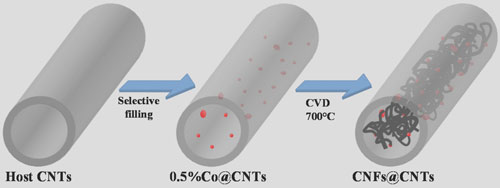
Su explains that the CNFs@CNTs were synthesized via selective deposition of an active metal on the inner walls of CNTs, which was followed by the growth of carbon nanofibers (CNFs) by means of catalytic chemical vapor deposition (CCVD).
"The Co@CNTs precursor, containing 0.5 wt% cobalt, was produced using a capillary force based incipient wetness impregnation methods, whereby a thin layer of cobalt nitrate solution is preferentially dispersed onto the inner surface of the CNTs. This causes the generation of metallic cobalt nanoparticles (average size: 6.6 nm) primarily on the inner wall of the CNTs during the subsequently performed H2 reduction step. These then act as active phase for CNF growth in the tubular chamber during the CCVD process."
Synthesis route to carbon-nanotube-encapsulated carbon nanofibers
Synthesis route to carbon-nanotube-encapsulated carbon nanofibers (CNFs@CNTs). (Reprinted with permission from Wiley-VCH Verlag)
The researchers found that the CNFs@CNTs with a novel structure possessed a much better porosity than the pristine nanotubes. "Nitrogen physisorption tests showed that the specific surface area and the pore volume increased from 82 m2 per gram and 0.17 cm3 per gram to 347 m2 per gram and 0.61 cm3 per gram, respectively" says Dr. Jian Zhang from the Fritz Haber Institute. " The total increase in weight was 25% as measured after the CCVD process; which suggests a greatly improved utilization of space inside the hollow channels of the CNTs, thus an increase in their bulk density. This arises primarily from the formation of secondary pores between the CNFs and CNTs as well as the extremely close stacking of CNFs inside the CNTs, because the produced CNFs alone could not contribute to such a great extent."
Su also notes that In terms of permanence of the high lithium storage capacity, CNFs@CNTs are superior to pristine CNTs. "During 120 cycles the reversible capacity of the CNFs@CNTs electrode stayed at around 410 mAh per gram while it gradually decreased to 258 mAh per gram when the electrode was formed from commercial CNTs."
The researchers hypothesize that the superior stability of these CNFs@CNTs probably arises from a steric hindrance effect of their compact structure which suppresses the diffusion of big electrolyte molecules through wall defects. The confinement of CNTs suppresses the exfoliation of CNFs during intercalation/de-intercalation of lithium ions, give the long time stability they observed.
Su points out that their outstanding cycling performance in combination with their high storage capacity makes CNFs@CNTs much more attractive than other carbon materials previously reported in the literature, such as for instance multi-walled CNTs, hard carbon, and CNFs.
"Our fabrication method can be extended to other carbon materials (mesoporous carbon, activated carbon, carbon nanocones, etc.) as well as one-dimensional inorganic nanotubes and nanofibers" he says.
For now, the scientists are working on the challenge of increasing the graphitization degree of carbon nanofibers inside CNTs. Eventually this could lead to much better performing Li-ion batteries. Another intriguing question is if this novel carbon composite material is suitable for hydrogen storage and at what performance.
By Michael Berger. Copyright 2008 Nanowerk LLC

Source

'Sticky Nanotubes' Hold Key To Future Technologies


This composite image taken with an electron microscope shows a side and bottom image of a nanotube attached to a "microcantilever," a component in atomic force microscopes. Researchers at Purdue used the experimental setup to precisely measure the forces required to peel nanotubes off of other materials, opening up the possibility of creating standards for nano-manufacturing and harnessing a gecko's ability to walk up walls. The nanotube in this image has a length of about 6 microns, or millionths of a meter, and is 40 nanometers wide, roughly 500 times thinner than a human hair. This image also shows an artistic representation of how a nanotube peels away from surfaces. (Credit: Birck Nanotechnology Center, Purdue University)

ScienceDaily (Apr. 29, 2008)
— Researchers at Purdue University are the first to precisely measure the forces required to peel tiny nanotubes off of other materials, opening up the possibility of creating standards for nano-manufacturing and harnessing a gecko's ability to walk up walls.

So-called "peel tests" are used extensively in manufacturing. Knowing how much force is needed to pull a material off of another material is essential for manufacturing, but no tests exist for nanoscale structures, said Arvind Raman, an associate professor of mechanical engineering at Purdue.

Researchers are trying to learn about the physics behind the "stiction," or how the tiny structures stick to other materials, to manufacture everything from nanoelectronics to composite materials, "nanotweezers" to medical devices using nanotubes, nanowires and biopolymers such as DNA and proteins, he said.

Flexible carbon nanotubes stick to surfaces differently than larger structures because of attractive forces between individual atoms called van der Waals forces.

"Operating in a nanoscale environment is sort of like having flypaper everywhere because of the attraction of van der Waals forces," Raman said. "These forces are very relevant on this size scale because a nanometer is about 10 atoms wide."

Mechanical engineering doctoral student Mark Strus made the first peeling-force measurements for nanotubes in research based at the Birck Nanotechnology Center in Purdue's Discovery Park.

Findings were detailed in a research paper published in February in the journal Nano Letters. The paper was written by Strus; materials engineering doctoral student Luis Zalamea; Raman; Byron Pipes, the John Leighton Bray Distinguished Professor of Engineering; NASA engineer Cattien Nguyen; and Eric Stach, an associate professor of materials engineering.

The energy it takes to peel a nanotube from a surface was measured in "nanonewtons," perhaps a billion times less energy than that required to lift a cup of coffee. That peeling energy is proportional to the nanotube's "interfacial energy," which is one measure of how sticky something is, Strus said.

"This whole idea of measuring the stickiness of something is a standard material test in industry," he said. "There are certain tests that you need to have for measuring strength, toughness and adhesion."

But until now, no such test had been completed to successfully measure and quantify these forces on the nanoscale.

Nanotubes offer promise to produce a new class of composite materials that are stronger than conventional composites for use in aircraft and vehicles.

"This is a big area of research primarily because the strength of nanotubes can be much greater than that of carbon nanofibers," Raman said.

However, properly integrating high-strength nanotubes into polymers for composite materials requires a knowledge of how the nanotubes stick to polymers and to each other.

"One of the big areas in composites, in general, and nanocomposites, in particular, is how to coat a fiber with a material that makes it stick better to the matrix," Raman said. "So it's really important to know how to judge which coatings work best for specific types of fibers. For larger fibers, industry knows which coatings work best, but such knowledge is scarce for nanoscale fibers. It's all about how to make nanotubes 'sticky' to the surrounding matrix."

Nanotubes also must be dispersed uniformly in a solution before being mixed with the polymer to make composite materials, but the tiny rods tend to clump together. Learning precisely how the tubes adhere to each other could lead to a method for dispersing them.

The findings also promise to help researchers understand how geckos are able to stick to surfaces, a trait that could translate into practical uses for industrial and military applications.

Tiny branching hairs called setae on the animal's front feet use van der Waals adhesion. "The question is, how does it stick, and, equally important, if the adhesion force is strong enough to hold its weight onto a surface like a wall, then how does it then unstick, or peel, itself to move up a vertical surface?" Strus said.

Nanotubes also have possible medical applications, such as creating more effective bone grafts and biomolecular templates to replace damaged tissues, which requires knowing precisely how the nanotubes adhere to cells.

Yet another potential application is a "nanotweezer" that might use two nanorods to manipulate components for tiny devices and machines.

Raman and Strus plotted how much force it took to peel nanotubes from surfaces, discovering that the tubes lift off in fits and starts instead of smoothly.

"We saw these jumps in peeling forces, where the nanotubes would lift off suddenly and then snag, lift off suddenly and then snag. This behavior has a very deep physical significance and can only be appreciated by means of mathematical models," Raman said.

Pipes and Zalamea, meanwhile, had already been developing theoretical models to describe how the nanotubes would peel away from a surface and from each other. The four researchers then worked together with the others to fine tune the model, which describes the physics of why nanotubes peel off unevenly.

The nanotubes used in the research had a length of about 6 microns, or millionths of a meter, and were 40 nanometers wide, roughly 500 times thinner than a human hair.

The researchers used an atomic force microscope to measure the peeling forces. The nanotube was attached to the end of a diving-board shaped part of the microscope called a microcantilever. As the nanotube was pulled away from a surface, the cantilever bent. This bending movement was tracked with a laser, revealing the forces required to peel the nanotube.

The carbon nanotubes for the research were provided by NASA. With the assistance of Stach, the structure of the nanotubes was characterized using a transmission electron microscope. The research was funded by the National Science Foundation and the Korean Center for Nanomanufacturing and Mechatronics. Strus' work is supported in part with a Bilsland Fellowship, which he was awarded this year.

Future work may focus on making measurements that apply to nanocomposites.

Adapted from materials provided by Purdue University.

Source

Samsung USP 7,365,482, April 29, 2008 - CNT FED


United States Patent 7,365,482
Ryu , et al. April 29, 2008

Field emission display including electron emission source formed in multi-layer structure

Abstract

A field emission display includes first and second substrates provided opposing one another with a predetermined gap therebetween; electron emission sources provided on one of the first and second substrates; an electron emission inducing assembly for inducing the emission of electrons from the electron emission sources; and an illuminating assembly provided on the substrate on which the electron emission sources are not formed, the illuminating assembly realizing images by the emission of electrons from the electron emission sources. The electron emission sources include a carbon nanotube layer and a base layer, the base layer connecting the carbon nanotube layer to the substrate and applying a voltage to the carbon nanotube layer required for the emission of electrons. Also, the carbon nanotube layer is provided on the base layer in a state substantially un-mixed with the base layer.


Inventors: Ryu; Mee-Ae (Suwon, KR), Kim; Hun-Young (Seoul, KR), Nam; Joong-Woo (Suwon, KR)
Assignee: Samsung SDI Co., Ltd. (Suwon-si, Gyeonggi-do, KR)
Appl. No.: 10/684,520
Filed: October 15, 2003

What is claimed is:

1. A field emission display, comprising: first and second substrates provided opposing one another with a predetermined gap therebetween to form a vacuum assembly; electron emission sources provided on one of the first and second substrates; an electron emission inducing assembly inducing the emission of electrons from the electron emission sources; and an illuminating assembly provided on the other one of the first and second substrates not including the electron emission sources being formed, the illuminating assembly realizing images by the emission of electrons from the electron emission sources, with the electron emission sources including a carbon nanotube layer and a base layer, said base layer having an outer surface that includes prominences and depressions, the base layer formed between the carbon nanotube layer and the one of the first and second substrates on which the electron emission sources are provided and having conductibility for applying a voltage to the carbon nanotube layer required for the emission of electrons, the carbon nanotube layer comprising a plurality of carbon nanotubes, and with the base layer having a predetermined thickness, and the carbon nanotube layer being provided on the base layer in a state substantially un-mixed with the base layer, the carbon nanotubes formed on both of the prominences and the depressions, wherein the base layer comprises: an adhesive material realized through a glass frit that selected from the group consisting of PbO, SiO.sub.2, Ba.sub.2O.sub.3, and a mixture thereof; and a metal conductive material selected from the group consisting of silver, copper, and aluminum.

Source

Monday, April 28, 2008

Gene silencing gets fat

28 April 2008

A team of researchers in the US has developed fat-like nanoparticles that can carry fragments of RNA into cells, bring treatments based on gene silencing a step closer.

RNA interference, or RNAi, is a method of switching off specific genes using short stretches of RNA called siRNA. The siRNA acts as a template that effectively cancels out the section of messenger RNA code that it matches - preventing a specific disease-causing protein from being made by a cell.

Many research teams and companies are developing RNAi-based therapies, but getting the RNA into cells through the fatty membrane that surrounds them has proved challenging.

Now Daniel Anderson from the Massachusetts Institute of Technology in the US, and his colleagues, have developed a method of making and screening huge numbers of lipid-like materials able to carry siRNA into cells where they can go to work silencing genes.

The team developed chemical methods to make a large library of lipid-like
materials called lipidoids. These form nanoparticles with nucleic acids such as RNA and DNA and carry them across cell membranes. Their methods were based on addition reactions between alkyl acrylates or alkyl acrylamides and primary or secondary amines.

'With the right starting materials, we can simply mix the reagents together and let the mixture cook - there's no need for a solvent or for multiple purification or protection steps. And we get a pretty complete conversion,' says Anderson.

The researchers synthesised a library of over 1200 lipidoids, and screened them for their ability to deliver siRNA into cells grown in a dish. The effective delivery agents were then tested in mice by attaching the agents to siRNAs that interfered with a blood clotting agent called factor VII, which is expressed in the liver. Using blood and liver tissue samples, the researchers were able to test for the levels of the mRNA they were looking to eliminate to determine how effective the treatment had been. They then went on to test the materials in other animal species including mice, rats, and monkeys.

"It's definitely a big step forward"
- Simone Hess

Simone Hess, who is developing RNAi therapeutics at the Max Planck Institute for Infection Biology in Berlin, Germany, describes delivery as 'the big issue' for the field. '[This study is] definitely a big step forward,' she says.

But Hess points out that the lipidoids aren't able to target the delivery to specific cells. A number of other research groups are experimenting with siRNAs attached to antibodies that target, for example, cancer cells.

Anderson agrees that targeted delivery is important for RNAi therapies, and is currently working on the synthesis of materials able to target specific cell types. 'A key thing about this study is that it greatly expands the collection of materials we can think about using.'

Victoria Gill

Source

Sunday, April 27, 2008

Rational design of amphiphilic polymers to make carbon nanotubes water-dispersible, anti-biofouling, and functionalizable

Chemical Communications


Free access
Communication

Article citation: Sangjin Park, Chem. Commun., 2008, DOI: 10.1039/b802057d


Rational design of amphiphilic polymers to make carbon nanotubes water-dispersible, anti-biofouling, and functionalizable

Sangjin Park, Hae-Sik Yang, Dongkyu Kim, Kyungmin Jo and Sangyong Jon


We report rational design of amphiphilic polymers capable of making carbon nanotubes (CNTs) highly water dispersible and resistant to biofouling; such CNTs can be conjugated with bioactive molecules so as to be potential drug delivery vehicles.

Graphical abstract image for this article  (ID: b802057d)

Source

Nanoscale tools to selectively destroy cancer cells

Chemical Communications

Article citation: Pierre-Luc Boudreault, Chem. Commun., 2008, DOI: 10.1039/b800528a


Nanoscale tools to selectively destroy cancer cells

Pierre-Luc Boudreault, Mathieu Arseneault, François Otis and Normand Voyer


We present experimental data that demonstrate the potential of synthetic crown ether modified peptide nanostructures to act as selective and efficient chemotherapeutic agents that operate by attacking and destroying cell membranes.

Graphical abstract image for this article  (ID: b800528a)

Source

Friday, April 25, 2008

UT Dallas, Brazilian Researchers Discover Remarkable New Properties for Nanotube Sheets

Strange, Useful Properties Obtained by Nanoscale Self Assembly are Reported in the April 25 Issue of Prestigious Scientific Journal

April 24, 2008

A team of nanotechnologists at The University of Texas at Dallas, along with Brazilian collaborators, have discovered that sheets of carbon nanotubes can produce bizarre mechanical properties when stretched or uniformly compressed. These unexpected but highly useful properties could be used for such applications as making composites, artificial muscles, gaskets or sensors.

The team’s findings are reported in the April 25 issue of the journal Science.

When most materials are pulled in one direction, they get thinner in the other direction, similar to how a rubber band behaves when it is stretched. However, specially designed carbon nanotube sheets, dubbed “buckypaper,” can increase in width when stretched. The buckypaper can also increase in both length and width when uniformly compressed.

Ordinary materials contract laterally when stretched — a phenomenon that can be quantified by Poisson’s ratio, which is the ratio of the percent lateral contraction to the percent applied stretch.

Without realizing it, people have been using Poisson’s ratio for more than 2,000 years — in the form of wine bottle corks. Corks have a near-zero but positive Poisson’s ratio, which makes them difficult to insert but easy to remove. The opposite would be true if the cork had a negative Poisson’s ratio.

Dr. Ray H. Baughman, Robert A. Welch Professor of Chemistry and director of UT Dallas’ NanoTech Institute, and his colleagues created their nanotube sheets, or buckypaper, by using ancient methods for making ordinary writing paper — by drying a fiber slurry (Figure 1). The slurry has a mixture of carbon single-walled nanotubes (SWNTs) and multi-walled nanotubes (MWNTs). The researchers found that increasing the amount of MWNTs in the paper produced a sharp transition from a positive Poisson’s ratio of about 0.06 to a much larger magnitude negative value of about -0.20.

As described by the team in Science, this transition can be understood by relating the deformation modes of the nanotube sheets to those of a collapsible wine rack (see Figure 2). If two neighboring nanotube layers are coupled like the struts in a compressible wine rack, Poisson’s ratio is positive and the rack becomes narrower when stretched. In contrast, if the rack is blocked so that it can no longer be collapsed but the struts are stretchable, increases in strut length produce a negative Poisson’s ratio.

“This abrupt switching of the sign of Poisson’s ratio is so surprising and the structure of the nanotube sheets is so complicated that we initially believed that quantitative explanation was impossible using state-of-art theoretical capabilities,” said Baughman, the article’s corresponding author. “Distant daily teaming with our Brazilian colleagues through the Internet enabled us to jointly extract essential features from a structure that was much too complex for complete analysis, leading to our successful wine-rack-like model.”

Baughman and his team subsequently found that the nanotube sheets containing both single-walled and multi-walled nanotubes had a 1.6 times higher strength-to-weight ratio, 1.4 times higher modulus-to-weight ratio and a 2.4 times higher toughness than sheets made of SWNTs or MWNTs alone.

According to Baughman, the implications of the discovery that properties can be enhanced by mixing nanotube types can likely be extended from nanotube sheets to other nanotube arrays, like the twisted nanotube yarns Baughman and colleagues invented in 2005.

Illustration of the oppositely directed lateral bending on forming a nanotube sheet strip into a ring, when the Poisson's ratio is positive (left) or negative (right). No lateral bending occurs when the Poisson's ratio is zero (middle).

Similarly, the ability to tune Poisson’s ratio (Figure 3) could be exploited for designing sheet-derived composites, artificial muscles, gaskets, stress and strain sensors and chemical sensors.

A thick nanotube sheet could also be made to wrap around a concave, convex, or saddle shaped surface depending on the sign of Poisson’s ratio — something that could come in useful for forming shaped composites.

By choosing the ratio of SWNTs and MWNTs, the Poisson ratio can be adjusted to zero, which is useful for designing cantilevers for sensing that do not distort in width during bending. Tensile sensors can provide a sensitivity that is proportional to the volume change produced by stretch, and this volume change can be increased by the team’s discovery of the tunability of Poisson’s ratio.

The breakthroughs resulted from the diverse expertise of the article’s co-authors, who come from around the world: Dr. Lee Hall and Dr. Ray Baughman from the U.S., Dr. Vitor Coluci, Dr. Douglas Galvão, and Dr. Sócrates Dantas from Brazil, Dr. Mikhail Kozlov from the Ukraine and Dr. Mei Zhang from China. Hall, the first author on the article, made his contributions to the discovery as part of his Ph.D. under the direction of Baughman. Lee and Baughman previously co-authored a paper in Science about fuel-powered artificial muscles.

The team’s research was funded by the National Science Foundation, the Air Force Office of Scientific Research, Lintec Corporation and the Brazilian agencies FAPESP and CNPq.

To obtain a copy of the Science article, please contact the journal at 202-326-6440 or scipak@aaas.org. A supplemental information file and figures describing applications evaluations that go beyond the scope of the Science article can also be found at scipak@aaas.org.


Media contacts: Jenni Huffenberger, UT Dallas, (972) 883-4431, jennib@utdallas.edu
or the Office of Media Relations, UT Dallas, (972) 883-2155, newscenter@utdallas.edu

Source

Wednesday, April 23, 2008

Nanobacteria – Are They Alive?

By Lisa Zyga
Calcium carbonate crystals (nanobacteria-like particles) have a cellular appearance but the new study shows that nanobacteria are not alive. Image credit: Martel and Young. 2008 PNAS.
Calcium carbonate crystals (nanobacteria-like particles) have a cellular appearance, but the new study shows that nanobacteria are not alive. Image credit: Martel and Young. ©2008 PNAS.

Tiny particles called nanobacteria have intrigued researchers in many ways since their discovery 20 years ago, but perhaps the most controversial question they pose is whether or not they are alive.
Nanobacteria – which sometimes go by the name “nanobes” or “calcifying nanoparticles” – don’t seem to fit scientists’ criteria for life. Researchers at a workshop hosted by the National Academy of Sciences for this specific reason concluded that the minimal cellular size of life on Earth must exceed 200 nm in diameter in order to contain the cellular machinery based on DNA replication. But nanobacteria can be as small as 80 nm – so, unless they contain some novel replicating mechanism, it seems unlikely that they constitute a form of life.

That’s just one piece of evidence against living nanobacteria named in a recent study by Jan Martel of Chang Gung University in Taiwan and John Ding-E Young from The Rockefeller University in New York, which was published in PNAS. Martel and Young have studied healthy human blood serum that contains what they call “nanobacteria-like particles” (NLP), composed of the compound calcium carbonate (CaCO3), or limestone. The researchers performed a series of experiments showing that the tiny particles contain no traces of DNA or RNA, and suggest that their formation can be explained by non-biological means.

“We believe that this study provides substantive proof that nanobacteria are not living entities,” Young told PhysOrg.com. “Some previous studies have hinted that this is the case, but have not provided a chemical composition or formulation that could explain the nanobacteria phenomenon in its entirety.”

One thing about nanobacteria that’s clear is that they’re very widespread, occurring in practically all human material tested. Under an electron microscope, nanobacteria (and the NLPs) look like typical bacteria, and even resemble cells undergoing division. They’re also hardy: when the researchers bombarded the NLPs with 30 kGy (kiloGray) of gamma radiation, it didn’t prevent them from growing in cultures, in accordance with previous studies.

Another bacteria-like property of NLPs is that they have the ability to nucleate hydroxyapatite (HAP), a calcium phosphate crystal that largely composes the bones and teeth of humans and animals. Previous research has suggested that this might be how the nanobacteria self-replicate. When Martel and Young investigated this issue in their study, however, they found that HAP only forms around NLPs under certain conditions. For example, when mixed with some crystal-growth-inhibiting proteins, NLPs stop nucleating HAP, indicating that HAP is not really necessary for NLP formation.

Instead, their experiments lead Martel and Young to suggest a chemical rather than biological model for NLP formation. Based on this hypothesis, they could control the speed and shape of NLP formation in vitro by simply varying the substrates needed for the precipitation of calcium carbonate.

These findings could also shed light on nanobacteria that have shown up in a variety of other areas, from sandstones of the Triassic and Jurassic eras to meteorite fragments from Mars. The chemical process that the researchers describe here for nanobacteria formation could be the same for these nanobacteria, as well.

“Nanobacteria have been heralded as the smallest cellular forms on Earth and as candidates to explain how cellular life began on Earth and other extraterrestial bodies, like meteorites and Mars,” Young said. “Our results clearly disprove that nanobacteria are living organisms. We have shown that all the previous vast body of literature in nanobacteria can actually be explained by a chemical and abiotic mechanism involving the simple deposition of limestone or calcium carbonate.”

Nano-pathogens?

Previous research has suggested that nanobacteria could be the cause of a wide variety of diseases, from kidney stones to atherosclerosis – a prospect which now must be tested with the new nanoparticles. Because they multiply faster in low-gravity environments, NASA is particularly concerned in light of astronauts’ increased risk for developing kidney stones. According to Martel and Young, these nanoparticles may be part of a much wider family of organic mineral complexes that seem to assemble and propagate as if they are alive – in fact, much like prions, the self-assembled proteins that cause mad cow disease.

“We believe that we have uncovered a whole family of organic mineral complexes that give the seeming appearance of replication and self-assembly as if they are live entities,” Young said. “They appear to be ubiquitous entities found in living and non-living substrates.”

Some researchers have even been developing antibodies to try to combat the “pathogenic” nanobacteria. A company called Nanobac Oy, owned by Nanobac Life Sciences and founded by the discoverers of nanobacteria, has antibodies that are commercially available and sells diagnostic kits for detecting the nanobacteria. The antibodies come from mice cells that have been immunized with nanobacteria obtained from cows.

To try to understand the nature of the reaction between the antibodies and nanobacteria, Martel and Young tested the antibodies on NLPs, which gave positive reaction, as expected. Surprisingly, however, the same antibodies also reacted with albumin, the most common protein in the blood serum. Since proteins like albumin can not possibly have been produced by any living bacteria, they’re probably attached to the calcium carbonate particles, and reacting with the antibodies, the researchers explain.

“Since nanobacteria have now been disproved as living entities, it is unlikely that they can produce diseases as bacteria would,” Young added. “Their common distribution in living and non-living environments – from blood to soil to meteorites – must be taken into account when speculating a role for them in disease. This is not to say that such nanoparticles are incapable of causing disease – with which they may very well be involved – but any such claims must be rigorously established through verifiable documentation, which is lacking at the present moment.”

More information: Martel, Jan, and Ding-E Young, John. “Purported nanobacteria in human blood as calcium carbonate nanoparticles.” Proceedings of the National Academy of Sciences. April 8, 2008. vol. 105, no. 14, 5549-5554.

Source

Cancer Fighting Virus Study/Reolysin

by Amy Fleming
KIMT News 3 & MedStarSource

San Antonio, TX - Sarcoma is a potentially deadly form of caner attacking the soft tissues and bones.

The Natiional Cancer Institute estimates about 12,000 people are dsiagnosed with it every year and nearly 5,000 die from it.

Now there's a treatment using a virus that's showing incredible results.

The novel treatment uses a living virus called Reolysin.

It's given to the patient intravenously every day for five days, every month.

It isn't a chemotherapy drug, but it is toxic to cancer cells.

Side effects from Reolysin are extremely mild compared to traditional treatments.

For more information on the study go to www.clinicaltrials.gov. Type the identification number is the search box: NCT00503295.

You can also call The Cancer Therapy & Research Center in San Antonio, TX at 210-450-5798.

Source

Tuesday, April 22, 2008

Bend-insensitive optical fibers simplify fiber-to-the-home installations

Optical fibers with bending loss several hundred times lower than standard single-mode fibers reduce installation costs for applications in multi-dwelling buildings.

The dream of installing optical fiber all the way to the home began in the early 1990s after extensive deployment of optical fibers in long-distance and metropolitan area networks.1 However, significant commercial deployment of fiber-to-the-home (FTTH) in North America started only a couple of years ago, led by Verizon. One reason for the slow growth of FTTH is higher installation costs compared to copper networks. Although optical fiber has superior signal capacity and immunity to electromagnetic interference, there is one basic aspect where fiber lags behind copper cable: the so-called ‘bending loss.’ When standard single-mode fiber (i.e., compliant to ITU-T Recommendation G.652, which defines the geometrical, mechanical, and transmission attributes of single-mode optical fibers) is used, the fiber cable must be installed very carefully to avoid small bends along the fiber path, which can cause signal loss. This is mainly a problem with inside plant cabling deployments such as those within multi-dwelling unit (MDU) buildings during which installers encounter numerous right-angle turns. In addition, the bending requirement for deployment dictates minimum dimensions of hardware and imposes significant costs for FTTH installations.

Figure 1. Fiber designs for reducing bending loss: (a) reduced mode field diameter (MFD) design; (b) depressed-cladding design; (c) trench fiber design; (d) hole-assisted design; and (e) nanoStructures design.

Several approaches have been proposed to reduce the bending loss of single-mode fibers. Many of these advancements have focused on changes to the cladding, a mirror-like sheath that helps contain the light waves within the core when the fiber is bent. Recent approaches include reducing the mode field diameter (MFD),2 depressing the cladding,3 adding a low index trench, 4,5,6 and adding a ring of symmetric holes within the cladding.7,8 Figure 1(a–d) shows schematics of these fiber designs. Among them, hole-assisted fibers, Figure 1(d), offer superior bending performance, but they are not compliant with ITU-T Recommendation G.652. In addition, the process for producing hole-assisted fibers is much more complicated than conventional fiber-making processes, making the fibers less attractive for large-scale and cost-sensitive FTTH implementation. Although conventional fiber design approaches deliver fibers that meet the standard requirements, their bending performance needs further improvement to meet the demanding requirements of low-cost FTTH installations.

Table 1. Typical optical characteristics of nanoStructures technology fiber.

Recently, we have developed a new fiber design technology, called nanoStructures™, for making optical fibers. This is a breakthrough technology that adds new dimensions to the conventional fiber design space. This technology enables new fiber designs with superior bend performance that meet the FTTH requirements and, at the same time, are compatible with large-scale manufacturing and field installation procedures. Figure 1(e) shows a schematic of our fiber design, which consists of a germania-doped core and a nanoStructures ring within the cladding. This fiber design consists of engineered features in the range of a few nanometers to several hundred nanometers.

This design offers several advantages compared with other technologies. First, the refractive index dependence of nanoStructures glass is very different from that of glass with conventional dopants used in fiber manufacturing. This refractive index has much stronger wavelength dependence than that of fluorine-doped glass. This dependence is explained schematically in Figure 2. Light at a longer wavelength sees more of the nanoStructures features than at a shorter wavelength. As a result, the average index change for these features increases with wavelength. This feature maximizes bend performance in the 1550nm window while maintaining a cable cutoff wavelength below 1260nm. Second, large, negative index changes can be made with our design. A relative index change as high as several percent can be achieved by using this new design. Such a high index change is very difficult to realize using the conventional fluorine-doping technology. Third, the scattering property of nanoStructures glass also has strong wavelength dependence. Light at shorter wavelengths has higher scattering losses than at longer wavelengths, which facilitates the tunneling of higher order modes through the ring. These new features can be used to design fibers with much better bending performance while other optical parameters stay compliant with the standards.


Figure 2. Different wavelengths see different refractive indices going through nanoStructures glass.

Figure 3. Comparison of bending loss of nanoStructures fiber with other fibers.

We made nanoStructures fibers using conventional outside vapor deposition (OVD) equipment. Fiber results demonstrate that this technology is compatible with the OVD process and suitable for large-scale production. Figure 3 compares typical bend losses as a function of bend radius for the nanoStructures fiber, standard single-mode fiber, and other bend-tolerant fibers at 1550nm. This figure shows that the nanoStructures fiber has about 500 times lower bending loss than the standard single-mode fiber, 100 times lower bending loss than the depressed-cladding fiber, and approximately 10 times lower bending loss than the trench fiber. The typical bending loss at a 5mm radius is 0.03dB/turn.

Other typically-measured optical properties of the fiber samples are summarized in Table 1. The optical parameters shown in Table 1 are fully compliant with the G.652 standards. We also evaluated fusion-splicing performance for these fibers. The fusion splicer was a Fujikura FSM 40S, and a splicing-factory-set splicing program was used. For splices between nanoStructures fibers, the average splice loss at 1310nm was 0.029dB. For the splices between nanoStructures and standard single-mode fibers, the average splice loss at 1310nm was 0.033dB. These results are similar to standard single-mode fibers.

In summary, our nanoStructures technology enables new fiber designs with ultra-low bending loss. The excellent bending performance of these fibers lends itself to the demanding installation requirements of FTTH networks in MDUs and makes them the best choice for such applications.


Ming-Jun Li
Corning Inc.
Corning, NY

Ming-Jun Li is a research fellow with Corning Inc. His research work is related to new fibers for different applications. He holds 33 US patents and has published one book chapter and authored and coauthored over 120 technical papers in journals and conferences.


DOI: 10.1117/2.1200803.0966

Source