Showing posts with label electrodes. Show all posts

Thursday, November 19, 2009

Nanotube defects equal better energy and storage systems

November 19, 2009
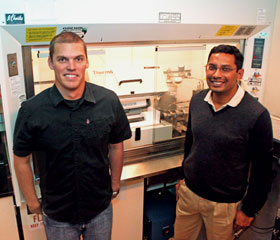
Photo of Mark Hoefer and Prabhakar Bandaru

Mark Hoefer (left), a UCSD materials science grad student, and mechanical
engineering professor Prabhakar Bandaru have discovered that defects in carbon
nanotubes could lead to supercapacitors that could possibly be used for portable
electronic devices such as cell phones.

Photo of Mark Hoefer and Prabhakar Bandaru


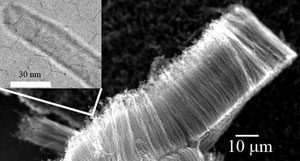
Carbon nanotubes could serve as supercapacitor electrodes with enhanced charge and energy storage capacity


(inset: a magnified view of a single carbon nanotube). Credit: UC San Diego


(PhysOrg.com) -- Most people would like to be able to charge their cell phones and other personal electronics quickly and not too often. A recent discovery made by UC San Diego engineers could lead to carbon nanotube-based supercapacitors that could do just this.


In recent research, published in Applied Physics Letters, Prabhakar Bandaru, a professor in the UCSD Department of Mechanical and Aerospace Engineering, along with graduate student Mark Hoefer, have found that artificially introduced defects in nanotubes can aid the development of supercapacitors.

"While batteries have large , they take a long time to charge; while electrostatic capacitors can charge quickly but typically have limited capacity. However, supercapacitors/electrochemical capacitors incorporate the advantages of both," Bandaru said.

Carbon nanotubes (CNTs) have been generally hailed as one of the wonder materials of the 21st century and have been widely recognized as ushering in the revolution. They are cylindrical structures, with diameters of 1 to 100 nanometers, that have been suggested to have outstanding structural, chemical, and electrical, characteristics based on their atomically perfect structures with a large surface area-to-volume ratio. However, defects are inevitable in such a practical structure, an aspect that was first investigated by UCSD engineering graduate student Jeff Nichols and then substantially extended by Hoefer in Bandaru's lab.

"We first realized that defective CNTs could be used for when we were investigating their use as electrodes for chemical sensors," Hoefer said. "During our initial tests we noticed that we were able to create charged defects that could be used to increase CNT charge storage capabilities."

Specifically, defects on nanotubes create additional charge sites enhancing the stored charge. The researchers have also discovered methods which could increase or decrease the charge associated with the defects by bombarding the CNTs with argon or hydrogen.

"It is important to control this process carefully as too many defects can deteriorate the electrical conductivity, which is the reason for the use of CNTs in the first place. Good conductivity helps in efficient charge transport and increases the power density of these devices," Bandaru added.

"At the very outset, it is interesting that CNTs, which are nominally considered perfect, could be useful with so many incorporated defects," he added.

The researchers think that the energy density and power density obtained through their work could be practically higher than existing capacitor configurations which suffer from problems associated with poor reliability, cost, and poor electrical characteristics.

Bandaru and Hoefer hope that their research could have major implications in the area of energy storage, a pertinent topic of today. "We hope that our research will spark future interest in utilizing CNTs as electrodes in charge storage devices with greater energy and power densities," Hoefer said.

While more research still needs to be done to figure out potential applications from this discovery, the engineers suggest that this research could lead to wide variety of commercial applications, and hope that more scientists and engineers will be compelled to work in this area, Bandaru said.

Meanwhile, Hoefer said this type of research will help fuel his future engineering career.

"It is remarkable how current tools and devices are becoming increasing more efficient and yet smaller due to discoveries made at the nanoscale," he said. "My time spent investigating CNTs and their potential uses at the Jacobs School will prepare me for my career, since future research will continue the trend of miniaturization while increasing efficiency."

More information: “Determination and enhancement of the capacitance contributions in carbon nanotube based electrode systems,” Applied Physics Letters. M. Hoefer and P.R. Bandaru.

Source: University of California - San Diego


Tuesday, April 29, 2008

Converting conventional nanotubes into superior carbon for batteries

Posted: April 29, 2008
Converting conventional nanotubes into superior carbon for batteries
(Nanowerk Spotlight) The race is on to develop the next generation of nanotechnology-enabled electrochemical energy storage devices, also knows as batteries. Lithium of course has long been recognized as an ideal material for energy storage due to its light weight and high electrochemical energy potential, as witnessed by the ubiquitous use of Li-ion batteries. There still seems to be considerable potential to further improve the performance characteristics of these Li-ion batteries (see our recent Spotlight: Using nanotechnology to improve Li-ion battery performance and this previous article: Nanotechnology batteries - the end of exploding batteries?). There have been many design approaches to creating lithium ion batteries but they usually share common features: The positive electrode is typically a lithium metal oxide, with various metals used such as cobalt, nickel, and manganese. The negative electrode is typically a carbon compound or natural or synthetic graphite. Researchers in Germany have now demonstrated a simple route for transforming cheap commercial carbon nanotubes into highly efficient carbon for electrochemical energy storage applications. When tested as electrode materials for lithium batteries, this composite material exhibits excellent performance over long test cycles.
"We were able to demonstrate, for the first time, the template-free synthesis of carbon nanotube (CNT) encapsulated carbon nanofibers (CNFs@CNTs), where cheap and low-quality commercial carbon nanotubes are transformed into high-performance electrode materials" Dr. Dangsheng Su tells Nanowerk. "Compared to single-walled CNTs, the CNTs used in our study had a lower surface area, bigger outer diameter (50–200 nm), and thicker walls (50–100 walls). Large-scale production reduced their price to as little as $50 per kilogram."
Su, who heads the Electron Microscopy & Microstructure Group in the Department of Inorganic Chemistry at the Fritz Haber Institute of the Max Planck Society in Berlin, Germany, together with colleagues from his institute and the Max Planck Institute for Solid State Research in Stuttgart, has found that this new class of carbon materials exhibits unique structural properties; which give it significant potential for applications in the field of gas adsorption, environmental protection, fuel cells, catalysis, hydrogen storage, etc.
These results have been reported in the March 28, 2008 online edition of Advanced Materials ("CNFs@CNTs: Superior Carbon for Electrochemical Energy Storage")
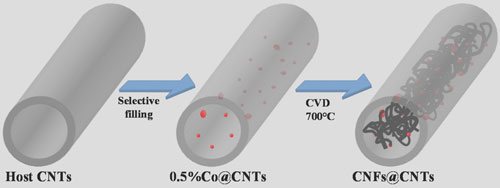
Su explains that the CNFs@CNTs were synthesized via selective deposition of an active metal on the inner walls of CNTs, which was followed by the growth of carbon nanofibers (CNFs) by means of catalytic chemical vapor deposition (CCVD).
"The Co@CNTs precursor, containing 0.5 wt% cobalt, was produced using a capillary force based incipient wetness impregnation methods, whereby a thin layer of cobalt nitrate solution is preferentially dispersed onto the inner surface of the CNTs. This causes the generation of metallic cobalt nanoparticles (average size: 6.6 nm) primarily on the inner wall of the CNTs during the subsequently performed H2 reduction step. These then act as active phase for CNF growth in the tubular chamber during the CCVD process."
Synthesis route to carbon-nanotube-encapsulated carbon nanofibers
Synthesis route to carbon-nanotube-encapsulated carbon nanofibers (CNFs@CNTs). (Reprinted with permission from Wiley-VCH Verlag)
The researchers found that the CNFs@CNTs with a novel structure possessed a much better porosity than the pristine nanotubes. "Nitrogen physisorption tests showed that the specific surface area and the pore volume increased from 82 m2 per gram and 0.17 cm3 per gram to 347 m2 per gram and 0.61 cm3 per gram, respectively" says Dr. Jian Zhang from the Fritz Haber Institute. " The total increase in weight was 25% as measured after the CCVD process; which suggests a greatly improved utilization of space inside the hollow channels of the CNTs, thus an increase in their bulk density. This arises primarily from the formation of secondary pores between the CNFs and CNTs as well as the extremely close stacking of CNFs inside the CNTs, because the produced CNFs alone could not contribute to such a great extent."
Su also notes that In terms of permanence of the high lithium storage capacity, CNFs@CNTs are superior to pristine CNTs. "During 120 cycles the reversible capacity of the CNFs@CNTs electrode stayed at around 410 mAh per gram while it gradually decreased to 258 mAh per gram when the electrode was formed from commercial CNTs."
The researchers hypothesize that the superior stability of these CNFs@CNTs probably arises from a steric hindrance effect of their compact structure which suppresses the diffusion of big electrolyte molecules through wall defects. The confinement of CNTs suppresses the exfoliation of CNFs during intercalation/de-intercalation of lithium ions, give the long time stability they observed.
Su points out that their outstanding cycling performance in combination with their high storage capacity makes CNFs@CNTs much more attractive than other carbon materials previously reported in the literature, such as for instance multi-walled CNTs, hard carbon, and CNFs.
"Our fabrication method can be extended to other carbon materials (mesoporous carbon, activated carbon, carbon nanocones, etc.) as well as one-dimensional inorganic nanotubes and nanofibers" he says.
For now, the scientists are working on the challenge of increasing the graphitization degree of carbon nanofibers inside CNTs. Eventually this could lead to much better performing Li-ion batteries. Another intriguing question is if this novel carbon composite material is suitable for hydrogen storage and at what performance.
By Michael Berger. Copyright 2008 Nanowerk LLC

Source

Thursday, February 14, 2008

METHOD FOR MANUFACTURING A FIELD EMITTER ELECTRODE USING THE ARRAY OF NANOWIRES

Publication Number: WO/2008/018701 International Application No.: PCT/KR2007/003572
Publication Date: 14.02.2008
International Filing Date: 25.07.2007

Applicants: KOREA ADVANCED INSTITUTE OF SCIENCE AND TECHNOLOGY

Abstract:
The present invention relates to a method for manufacturing a field emitter electrode, in which nanowires are aligned horizontally, perpendicularly or at any angle between horizontal and perpendicular according to the direction of a generated electromagnetic field. More particularly, the present invention relates to a method for manufacturing a field emitter electrode having nanowires aligned horizontally, perpendicularly or at any angle between horizontal and perpendicular according to the direction of a generated electromagnetic field, the method comprising the steps of diluting nanowires in a solvent, dispersing the resulting solution on a substrate fixed to the upper part of an electromagnetic field generator, and fixing the nanowires aligned in the direction of an electromagnetic field generated from the electromagnetic field generator. According to the present invention, a high capacity field emitter electrode having high density nanowires aligned according to the direction of a generated electromagnetic field can be fabricated by a simple process and nanowires can be used as positive electrode materials for field emission displays (FEDs), sensors, electrodes, backlights and the like.

http://tinyurl.com/2m7dfw