Saturday, August 30, 2008

Listeria Death Toll Grows To 12 And More Cases Surface, With Ontario Being The Worst Hit Area - A possible answer

Video News DirectorWatch
Monday August 25, 2008
The death toll from the listeriosis outbreak is now at 12 - with six confirmed, and another 6 suspected - and the number of possible cases has topped 26, eleven of which are from Ontario.

The figures were confirmed Monday by Agriculture Minister Gerry Ritz and the Canadian Food Inspection Agency as the Maple Leaf Foods investigation continues.

It's not that anything has really changed since the previous numbers were released. It's more that officials have now widened the criteria they're using to count the victims, allowing for more possible deaths and more potential cases.

Ritz is warning those numbers are expected to climb as the incubation period continues to lengthen. It can take up to 70 days before symptoms show up in the most vulnerable.

"It is important to note that all the suspect cases have been diagnosed with listeriosis but it is only via laboratory testing, the generic fingerprint, that they determine if they are directly linked to this particular outbreak strain," Ritz explains. "We fully expect that both the numbers of suspected cases and confirmed cases will increase as this investigation continues and samples continue to be tested."

Why the big shift and dramatic increase in death assessments?

"It may seem like a huge jump," agrees CityNews Medical Specialist Dr. Karl Kabasele. "Going into the weekend, we were talking about 3 or 4 deaths. Now we're talking 12. The reason is a change in the definition of what constitutes a death related to this outbreak.

"Previously we were only talking about people for whom the coroner or another physician may have said the official cause of death was literiosis. Now that definition has been expanded and we're talking about anyone for whom listeriosis was a contributing factor to their death."

It means they may not have died directly from the bad bug but could have had it when they expired from something else.

All this comes as one of the largest product recalls in Canadian history continues, a call back that's costing the company at the centre of it millions of dollars.

Maple Leaf Foods has taken out huge ads apologizing for the crisis and is trying hard to make what amends it can.

"When listeria was discovered in the product, we launched immediate recalls to get it off the shelf. Then we shut the plant down. Tragically our products have been linked to illnesses and loss of life. To Canadians who are ill and for the family who have lost loved ones, I offer my deepest sympathies," Michael McCain, Maple Leaf Foods president, revealed in a televised statement. (See it here.)

There are now 220 products on the recall list after the Canadian Food Inspection Agency confirmed the company's plant near Sheppard Ave. and Highway 401 as the source of a recent outbreak of the bacteria listeria monocytogenes, which can cause the illness listeriosis.

Among the brands listed among the recalled items - Maple Leaf, Equity, Schneiders, and Shopsy's. They all have a key code of establishment 97B on them.

However, Shopsy's restaurants are not affected.

"Shopsy's Deli Restaurants is a different company than Maple Leaf Foods. We do share the trademark and they do package some foods under the Shopsy's brand but we do not serve those meats in our deli sandwiches at the restaurant," reiterated company president Gavin Quinn.

The North York plant was closed last week for disinfection, and if it passes strict tests it could reopen Tuesday.

"How it (listeria) got there or where exactly it is in that equipment, we may never know," admits Maple Leaf foods Linda Smith.

"That's why we instituted this much broader recall of 220 products, even though we don't have test results that say there might be listeria there. If there is a doubt, if there is a possibility, and we understand it's extensive in a long line of products and to consumers we apologize about that because we know many of them are checking products, and it's a process.

"We just want to do the right thing. And over time, consumers will make their own decisions."

The recall affected a number of restaurants as well, including McDonald's, Mr. Sub, Tim Hortons, and Boston Pizza. All have removed the meats from their menus.

The CFIA was first made aware of the problem on August 4. Federal Health Minister Tony Clement said the government response to the outbreak was appropriate, even though some complained it took too long from the time suspicions arose to the recall notice.

"The surveillance system picked up a problem that was occurring and allowed us to respond efficiently and effectively to an emerging public health issue," Clement said in a news conference Sunday.

Clement said it was tragic that four people died but noted "this is an example of where our surveillance system worked."

McCain estimated the recall would cost the company $20 million - ten times the original figure estimated when the list of recalled products was about two dozen. He said the decision to expand the recall was for safety reasons after the link was made between the listeriosis outbreak and the GTA plant.

"We felt, given the new information, we had to take the most conservative approach possible, and recalled 100 per cent of the production from the entire facility," McCain said.

"We have an unwavering commitment to keeping our food safe with the standards that go well beyond regulatory requirements," he added. "But this week, our best efforts failed and for that, we are deeply sorry."

That $20 million figure does not include the possible lawsuits that may follow from the families of those who got sick or perished from the outbreak.

Consumer confidence has definitely taken a hit.

"I'm cautious now when I'm shopping, for sure," said one Torontonian.

When CityNews asked another shopper if they would buy Maple Leaf products in the future, she quickly responded, "Probably not."

Maple Leaf has posted a full list of products affected on the company's website. To see it in a PDF version, click here.

There's also a list on the CFIA site - click here to see it.

Are you at risk for listeriosis?

How to minimize your risk

Maple Leaf Foods stock takes huge tumble on markets

Source

A possible non-radioactive sterilization remedy:

Large area electron source


Publication number:US2004183032
Publication date:2004-09-23
Inventor:FINK RICHARD LEE (US); THUESEN LEIF H (US)
Applicant:NANO PROPRIETARY INC (US)
Classification:
- international:H01J33/00; H01J33/00; (IPC1-7): H01J33/00
- European: H01J33/00
Application number:US20040765533 20040127
Priority number(s):US20040765533 20040127; US20020262997 20021002; US20010326868P 20011003; US20010330358P 20011018


View INPADOC patent family
View list of citing documents

Also published as:

US7078716 (B2)

US6750461 (B2)

US2003062488 (A1)


Abstract of US2004183032
By using a large area cathode, an electron source can be made that can irradiate a large area more uniformly and more efficiently than currently available devices. The electron emitter can be a carbon film cold cathode, a microtip or some other emitter. It can be patterned. The cathode can be assembled with electrodes for scanning the electron source.

BACKGROUND INFORMATION
[0003] Electron beams can be used to sterilize medical instruments, food and packaging. Irradiation by electrons is an accepted medical treatment for certain skin cancers. Environmental uses are cleaning flue gasses and decontamination of medical waste. Industrial applications are drying of inks and polymer crosslinking.
.....
Referring to FIG. 8, there is illustrated a method for irradiating objects, such as mail 802, which may pass underneath the electron source 801 on a conveyor belt 803. The electron beams will pass through the envelope. Some energy may be lost at each surface of the letter killing or rendering harmless bacteria or virus species or toxic or other dangerous chemical compounds. Even though the figure shows an electron beam being applied from one side only onto the object, a plurality of e-beam soures can be utilized to arradiate the object 802 from different angles.

Source
USP 7,078,716
USP 6,750,461

So, perhaps Nano-Proprietary, now called Applied Nanotech Holdings, Inc. (APNT), has the answer. And no radioactivity (which disturbs consumers!) is involved.

Applied Nanotech contact details:

Email Contacts

  • Dr. Zvi Yaniv President & CEO of Applied Nanotech, Inc.
  • Dr. Richard Fink Vice President, R&D, Applied Nanotech, Inc.
  • Doug Baker Investor Relations and Chief Financial Officer, Applied Nanotech Holdings, Inc.

Investor Relations Contact

  • Doug Baker 248.391.0612

Phn 512.339.5020

Fax 512.339.5021

Address

3006 Longhorn Blvd., Suite 107

Austin, TX 78758

Map/Driving Directions

Source

Boise State research breakthrough may be 'magic bullet' for cancer treatment

Edition Date: 08/29/08

Boise State researchers have made a breakthrough in cancer treatment that may provide the “magic bullet” for the debilitating effects of chemotherapy.

The interdisciplinary group of researchers applied emerging nanotechnology techniques to traditional cancer research to come up with a highly effective method for the preferential killing of cancer cells while leaving ordinary cells healthy. This nanobiotechnology group is led by Boise State physics professor Alex Punnoose with strong contributions from biology professors Denise Wingett and Kevin Feris.

“One of the greatest challenges preventing advances in new therapeutic options for treating cancer is the inability of anticancer drugs to effectively differentiate between cancerous and normal healthy body cells,” said Wingett, a cancer researcher. “Many commonly used chemotherapeutic drugs target rapidly dividing cells but suffer from a relatively low therapeutic index, which is the ratio of toxic dose to effective dose.”

But the group discovered that zinc-oxide nanoparticles can preferentially kill cancer cells without impacting normal cells, a discovery that could potentially treat the cancer without the side effects caused by chemotherapy.

The group’s discovery is described in the paper “Preferential Killing of Cancer Cells and Activated Human T Cells Using ZnO Nanoparticles,” published in the July edition of the journal Nanotechnology. The paper has garnered significant attention in the scientific community, being downloaded more than 250 times in the first month of its publication, making it one of most popular articles in the 58 journals published by the Institute of Physics, the publisher of the journal Nanotechnology.

The article can be found online at: http://stacks.iop.org/0957-4484/19/295103.

“Until now, no group in the world has been able to produce inherent selective cancer-killing ability in nanoparticles,” Wingett said. “Current chemotherapy drugs typically consist of single molecules and do not provide much room for manipulation of the molecule. But nanoparticles can be modified so that certain characteristics, like cancer-killing attributes, can be accentuated. Because of this, we think there is room for improvement in what we have already demonstrated.”

Wingett said the selectivity of these nanomaterials may be enhanced by linking tumor-targeting proteins such as monoclonal antibodies, peptides, and small molecules to tumor-associated proteins, or by using nanoparticles for drug delivery. In addition to these future directions, the research team is exploring the possibility of altering the nanoparticles to further improve their inherent ability to kill cancer cells while sparing normal healthy body cells.

Cancer researchers across the country have taken notice of the work. Jame Abraham, the hematology/oncology section chief, director of the Comprehensive Breast Cancer Program and medical director at Mary Babb Randolph Cancer Center at West Virginia University, said that while more study is needed, the breakthrough has great promise.

“Oncology is always looking for a magic bullet, which can kill only the cancer cells, not killing the normal cells. This work is a major step toward that,” Abraham said. “I think this work will pave the way for more targeted therapies.”

The promise of the work has also helped the nanobiotech research group land a $503,000 National Science Foundation grant to acquire a fluorescent activated cell sorter that will give the research group greater ability to identify, analyze and sort nanoparticles.

In addition to enhancing this particular cancer research, the new equipment would support the research activity of at least 16 other Boise State researchers in the sciences, environmental health and engineering, as well as research being done at Northwest Nazarene University, the College of Idaho, the Boise Veterans Administration Medical Center, the Mountain States Tumor and Medical Research Institute and the local biotechnology industry.

Source

Thursday, August 28, 2008

Beyond Nano Breakthrough, MIT Team Quietly Builds Virus-Based Batteries

August 28, 2008

(Photo Courtesy of Belcher Laboratory/MIT)

CAMBRIDGE, Mass. — In a surprise power development that could have implications for electronics, cars and even the military, researchers at MIT have created the world's first batteries constructed at the nano-scale by microscopic viruses.

A much buzzed-about paper published in the Proceedings of the National Academy of Sciences earlier this month details the team's success in creating two of the three parts of a working battery—the positively charged anode and the electrolyte. But team leader Angela Belcher told PM yesterday that the team has been working seriously on cathode technology for the past year, creating several complete prototypes.

"We haven't published those yet, actually. We're just getting ready to write them up and send them off," says Belcher, who won a MacArthur "genius" grant from the for her work in 2004, and a Breakthrough Award from PM in 2006. "The cathode material has been a little more difficult, but we have several different candidates, and we have made full, working batteries."

Instead of physically arranging the component parts, researchers genetically engineer viruses to attract individual molecules of materials they're interested in, like cobalt oxide, from a solution, autonomously forming wires 17,000 times thinner than a sheet of paper that pack themselves together to form electrodes smaller than a human cell.

"Once you do the genetic engineering with the viruses themselves, you pour in the solution and they grow the right combination of these materials on them," Belcher says.

The team is working on three main architectures: Film-like structures—as small as a human cell—could form a clear film to power lab-on-a-chip applications, laminate into smart-cards, or even interface with implanted medical devices. Mesh-like architectures—billions of tiny nano-components all interfaced together—might one day replace conventional batteries in larger applications like laptops and cars. And fiber-like configurations—spun from liquid crystal like a spider's silk—might one day be woven into textiles, providing a wearable power-source for the military. "We definitely don't have full batteries on those [fiber architectures]. We've only worked on single electrodes so far, but the idea is to try to make these fiber batteries that could be integrated into textiles and woven into lots of different shapes," Belcher says.

The M13 viruses used by the team can't reproduce by themselves, and are only capable of infecting bacteria. At just 880 nanometers long—500 times smaller than a grain of salt—the bugs allow researchers to work at room temperatures and pressures with molecular precision, using and wasting fewer hazardous materials. Now that they've demonstrated that the construction of such tiny electronic components is possible, the challenge facing researchers is how to make them practical.

"What we're working on is not thinking about a particular device application, but trying to improve the quality of the anode and cathode materials—using biology just to make a higher quality material for energy density," Belcher says. "We haven't ruled out cars. That's a lot of amplification. But right now the thing is trying to make the best material possible, and if we get a really great material, then we have to think about how do you scale it." — Chris Ladd

Source

GAS IONIZER

(WO/2008/103733) GAS IONIZER

Latest bibliographic data on file with the International Bureau
Pub. No.:
WO/2008/103733
International Application No.:
PCT/US2008/054425
Publication Date:28.08.2008 International Filing Date:20.02.2008
IPC: H01J 27/26 (2006.01), H01J 49/16 (2006.01)
Applicants:APPLIED NANOTECH, INC. [US/US]; 3006 Longhorn Blvd., Suite 107, Austin, Texas 78758-7631 (US) (All Except US).
SIONEX CORPORATION [US/US]; 8-A Preston Court, Bedford, Massachusetts 01730 (US) (All Except US).
NAZAROV, Erkinjon, G. [US/US]; 58 Emerson Gardens, Lexington, Massachusetts 02420 (US).
FINK, Richard, Lee [US/US]; 9306 Rolling Oaks Trail, Austin, TX 78750 (US) (US Only).
KRYLOV, Evgeny [RU/US]; 158 Concord Road, Billerica, Massachusetts 01821 (US).
MARKOSKI, Kenneth, A. [US/US]; 42 Vose Hill Road, Westford, Massachusetts 01886 (US).
MILLER, Raanan, A. [US/US]; 27 Intervale Road, Chestnut Hill, Massachusetts 02467 (US).
Inventors:NAZAROV, Erkinjon, G.; 58 Emerson Gardens, Lexington, Massachusetts 02420 (US).
FINK, Richard, Lee; 9306 Rolling Oaks Trail, Austin, TX 78750 (US).
KRYLOV, Evgeny; 158 Concord Road, Billerica, Massachusetts 01821 (US).
MARKOSKI, Kenneth, A.; 42 Vose Hill Road, Westford, Massachusetts 01886 (US).
MILLER, Raanan, A.; 27 Intervale Road, Chestnut Hill, Massachusetts 02467 (US).
Agent:KORDZIK, Kelly, K.; Fish & Richardson P.C., P.O. Box 1022, Minneapolis, MN 55440-1022 (US).
Priority Data:
60/902,487
20.02.2007
US
Title: GAS IONIZER
Abstract:
Field emission based ionization sources are provided, with the emitter (305) being a carbon nanotube field emitter. Such emitters can replace Ni-63 beta emitters. Ionization of a gas (308) that is flowed through the gap (310) between the emitter plates (301, 302) is performed by electron capture of the flow of electrons by the molecules in the gas (308).


WHAT IS CLAIMED IS:

1. A method for ionizing a gas comprising: flowing a gas between first and second conductors, the first conductor further comprising a first coating containing nano-structures; and applying a voltage potential between the first and second conductors causing molecules in the gas to form ions, wherein electrons flowing between the molecules and the first conductor are emitted from or captured by the nano-structures.

Source

LUBRICANT ENHANCED NANOCOMPOSITES

United States Patent Application 20080206559
Kind Code A1
LI; YUNJUN ; et al. August 28, 2008

LUBRICANT ENHANCED NANOCOMPOSITES

Abstract

Strings configured for use in sports racquets and musical instruments are fabricated as a plastic core wrapped with one or more filaments of plastic. The strings are coated with a material composite that includes rigid nanoparticles, and lubricated nylon. The rigid nanoparticles may include clay or carbon nanotubes. The strings are coated with the material composite using various processes that result in a coating thickness of between 0.1 and 200 .mu.m. The material composite may further include impact modifiers. The strings experience extended life due to reduced frictional wear and improved mechanical properties.


Inventors: LI; YUNJUN; (Austin, TX) ; Yaniv; Zvi; (Austin, TX) ; Mao; Dongsheng; (Austin, TX)
Correspondence Name and Address:
    FISH & RICHARDSON P.C.
P.O BOX 1022
Minneapolis
MN
55440-1022
US
Serial No.: 036438
Series Code: 12
Filed: February 25, 2008

U.S. Current Class: 428/368; 473/543; 524/445; 524/495; 524/612
U.S. Class at Publication: 428/368; 524/612; 524/445; 524/495; 473/543
Intern'l Class: C08K 3/34 20060101 C08K003/34; C08K 3/04 20060101 C08K003/04; A63B 49/00 20060101 A63B049/00


Claims


1. A material composite comprising rigid nanoparticles, and lubricated nylon.

2. The composite of claim 1, wherein the rigid nanoparticles comprise carbon nanotubes or clay particles.

3. The composite of claim 1, wherein the lubricated nylon may comprise graphite, molybdenum disulfide, Silicone, Teflon.RTM., and titanium dioxide.

4. The composite of claim 1, further comprising impact modifiers selected from a set of impact modifiers including styrene-ethylene/butylene-styrene (SEBS), maleic anhydride grafted ethylene and propylene copolymer, a plasticizer, a compatiblizer, and combinations therein.

Source

Low Work Function Material

United States Patent Application 20080206448
Kind Code A1
Mao; Dongsheng ; et al. August 28, 2008

Low Work Function Material

Abstract

The present invention is directed toward methods for incorporating low work function metals and salts of such metals into carbon nanotubes for use as field emitting materials. The present invention is also directed toward field emission devices, and associated components, comprising treated carbon nanotubes that have, incorporated into them, low work function metals and/or metal salts, and methods for making same. The treatments of the carbon nanotubes with the low work function metals and/or metal salts serve to improve their field emission properties relative to untreated carbon nanotubes when employed as a cathode material in field emission devices.


Inventors: Mao; Dongsheng; (Austin, TX) ; Yaniv; Zvi; (Austin, TX) ; Fink; Richard Lee; (Austin, TX) ; Pavlovsky; Igor; (Austin, TX)
Correspondence Name and Address:
    FISH & RICHARDSON P.C.
P.O BOX 1022
Minneapolis
MN
55440-1022
US
Assignee Name and Adress: Nano-Proprietary, Inc.

Serial No.: 028171
Series Code: 12
Filed: February 8, 2008

U.S. Current Class: 427/77; 427/443.2; 977/742; 977/750; 977/752; 977/847
U.S. Class at Publication: 427/77; 427/443.2; 977/742; 977/750; 977/752; 977/847
Intern'l Class: B05D 5/12 20060101 B05D005/12


Claims


1. A method comprising the steps of :a) dispersing carbon nanotubes in a metal salt solution comprising a solvent; and b) removing the solvent to yield metal salt-treated carbon nanotubes.

[0079]It can be seen from FIG. 12 that the Cs salt-treated CNTs have significantly better field emission properties than untreated CNTs. A threshold field of less than 0.9 V/.mu.m and emission current of 30 mA at 1.84 V/.mu.m was achieved for the Cs salt-treated CNTs, whereas the untreated CNTs exhibited a threshold field of about 1.3 V/.mu.m and required a field of approximately 2.80 V/.mu.m to generate an emission current of 30 mA.


Source

Advances in nanomedicine - understanding the intricacies of nanoparticle drug delivery

Posted: August 28, 2008
(Nanowerk Spotlight) Nanomedicine, especially drug delivery with nano-sized drug carriers, is all the rage these days. The concept sounds simple: make nanoscale containers that can escape detection by the body's defense mechanisms, fill them with a drug, get them to the desired location within the body, release the drug payload and, presto, you've got a very effective and efficient weapon for instance to fight cancer. That this model works in principle has already been demonstrated in numerous studies. The same studies show the complicated nature and the many difficulties that scientists are facing in fabricating the right nanocontainers, getting them to the right location, controlling the release mechanism of the drug, measuring the drugs' efficacy, and monitoring the now empty delivery vehicles' fate.
In a previous Spotlight – Mathematical engines of nanomedicine – we described the vast complexities in designing effective nanoparticles that take into account a wide range of possible design parameters (such as size, shape, surface properties, bulk properties, surface density of targeting moieties) and the biological characteristics of the cellular target in the body (such as receptor density, blood-flow descriptors, wall permeability). The findings we described in this article also indicate that almost all the nanocarriers that are in the clinic or in the preclinical pipeline today are basically the worst possible size and shape for their intended purpose.
That engineered nanomaterials, especially inorganic ones, will be used for nanomedicine applications has now become a certainty. However, the use of these nanomaterials should occur with detailed knowledge of delivery, fate and functioning at the target, and finally release from the body. And that's an area where a lot of unanswered questions remain.
In particular, the question of what happens if (and that still often is a big if) the drug-containing nanoparticles reach their intended target is a crucial one: How do the drug molecules get released from the delivery vehicle? In other words, how does the 'envelope' get opened? What is the fate of the nanoparticles (drugs as well as containers) post opening? New work done by scientists in India is contributing to how the nanoscience community is tackling these issues.
Researchers from the Indian Institute of Technology Guwahati present experimental results which suggest that the specificity of release of encapsulated nanoparticles could be achieved with an appropriate combination of encapsulating materials and the choice of an appropriate enzyme that would cleave the encapsulation to release the nanoparticles.
"We have shown that the release of nanoparticles encapsulated in biofriendly starch by specific enzymes can serve as a prototype model for studying the digestion of biofunctionalized nanoparticles and may open newer research avenues where the stabilization and release of nanoparticles could be achieved using well-known therapeutic biomolecules," Dr. Arun Chattopadhyay tells Nanowerk.
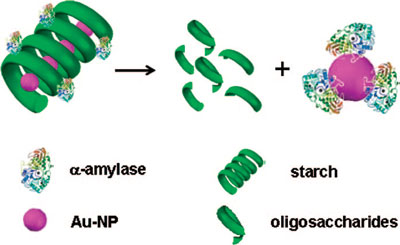
proposed mechanism of gold nanoparticle transfer from starch-gold nanoparticle composite to an enzyme
Schematic representation of the proposed mechanism of gold nanoparticle transfer from the starch-gold nanoparticle composite to the enzyme. The 3D structure of α-amylase is retrieved from Protein Data Base (PDB) entry 1DHK. (Reprinted with permission from American Chemical Society)
Chattopadhyay, a professor in the Department of Chemistry at the Indian Institute of Technology Guwahati, together with his colleagues, has published his findings in the August 20, 2008 online edition of Langmuir ("Probing Au Nanoparticle Uptake by Enzyme Following the Digestion of a Starch-Au-Nanoparticle Composite").
In this paper, the IIT team reports the results of studies on the enzymatic release of gold nanoparticles encapsulated in starch.
"In particular, we observed that the digestion of a gold nanoparticles-starch composite by α-amylase not only led to the degradation of starch into its lower analogues but also resulted in the release of encapsulated gold nanoparticles and their subsequent uptake by the enzyme" Chattopadhyay explains. "In addition to conventional biochemical and microscopy probes, the surface plasmon resonance (SPR) of gold nanoparticles provided a convenient way of following the reaction and establishing the mechanism. Our observations indicated that the rate of digestion of the starch-gold nanoparticles composite by alpha amylase was similar to that of pure starch and the free thiol groups of the enzyme possibly facilitated the uptake of gold nanoparticles by the enzyme in comparison to other carbohydrate-degrading enzymes such as amyloglucosidase."
These results could be particularly useful for nanoscale drug delivery and imaging studies in vitro. For example, if one wants to screen microorganisms that produce alpha amylase this method would allow a quick and easy way of doing that: the test of the presence of alpha amylase (produced by microorganisms) could be done by the starch-gold nanoparticle composite, which subsequently would release the nanoparticles (catalyzed by the enzyme). Of course, details of the concentrations of the composite etc. would still need to be worked out.
Chattopadhyay gives another example: "If one is interested in screening alpha amylase inhibitors then similar method could be used for that purpose. Alpha amylase inhibitors are known in plants to play important roles in rendering pest resistance attributes to the plants. Hence, there is a tremendous interest in developing transgenic plants bearing such inhibitors. The screening of the inhibitors produced by the plant (or the functional assay of the inhibitors) could be done based on the present method., i.e. measuring the change in localized SPR of gold nanoparticles."
The IIT scientists are currently working on two major areas in the nanomedicine field – fundamental understanding of phenomena related to the development of nanomaterial based diagnostics and therapeutics.
"While conventional diagnostics take either a long time to complete, may involve cumbersome steps, are too expensive to be affordable for a large section of the population, or exhibit low efficiency or sensitivity, the use of nanomaterials could be of great help in overcoming those disadvantages" says Chattopadhyay. "The question is: can one address these downsides systematically, with a reasonably good understanding of the science part of the process? We would like to do that systematically at least in some of the cases."
He mentions that he and his IIT colleagues are also working on the development of nanomaterials-based therapeutics. "For example, we have recently shown that use of silver nanoparticles in conjunction with gene therapy may be a better option for anti-cancer therapy than the use of either of them ("Implications of silver nanoparticle induced cell apoptosis for in vitro gene therapy"). We are currently working on the use of composites rather that use of nanoparticles alone for similar purposes. That way the use of each component (of the composite) would be minimized, while the efficiency of the composite would be better than the isolated components at lower concentrations."
By Michael Berger. Copyright 2008 Nanowerk LLC
Source

Nanoparticles Stick a Perfect Landing

Phys. Rev. B 78, 081405
(issue of August 2008)
Title and Authors

27 August 2008

time sequences of simulated nanoparticles


T. Dumitrică/Univ. of Minnesota

On the rebound. A nanoparticle containing some 30,000 silicon atoms and moving at 900 meters per second will bounce off a surface (left sequence), but at 2,000 meters per second, it sticks (right sequence), according to computer simulations. The higher-speed impact causes two sequential changes in the crystalline structure.

A silicon nanoparticle flying at 8 times the speed of sound can slam into a surface and stick, but it bounces off if colliding at half that speed. This puzzling observation is now explained by computer simulations reported in the August Physical Review B. The pressure of impact causes the higher speed particle to change its crystalline structure, which soaks up so much energy that the particle can't bounce away. These results may help researchers who are developing wear-resistant coatings that are created by many such high-speed impacts.

Steven Girshick and his team at the University of Minnesota in Minneapolis are designing super-hard, wear-resistant coatings for machine tools. In their patented technique, a spray of particles--each a few nanometers across and containing silicon or some combination of chemicals--strikes a target substrate, such as a silicon surface, with velocities between 1 and 2 kilometers per second. The lumpy coating is built up as these nanoparticles stick to the surface. This technique can create similar rough-textured coatings that are being developed for other purposes, such as for sensors and catalysts.

Girshick's team uses high-speed nanoparticles because they stick without splattering, unlike lower-speed particles, but the team never understood why the higher speed helps. Sticking implies that the kinetic energy is changed into another form, or "dissipated." If these were macroscopic objects--like sticky BBs shot into a wall--the energy would dissipate through buckling or crumpling in the crystalline structure. "But at the nanoscale, there is not enough space or time to create these dislocations," says Traian Dumitrică, also at the University of Minnesota.

To investigate where the energy goes, Dumitrică and graduate student Mayur Suri ran computer simulations of a hypersonic nanoparticle. They began with a sphere of 30,000 silicon atoms arranged in a diamond-like crystalline structure in which each atom bonds to four neighbors. They then simulated this nanoparticle smashing into a silicon surface.

They found that for speeds less than 1.2 kilometers per second, the nanoparticle bounces off the surface like a basketball. But at higher speeds, some of the nanoparticle undergoes a phase transition to a compressed state called β-tin, where each atom bonds to six neighbors. This transition is surprising, Dumitrică says, because the collision energy is not high enough to induce a phase transition in a macroscopic object. However, the impact force is applied over a few square nanometers, so the pressure inside the nanoparticle is extremely large--around 200,000 atmospheres, which is more than enough to cause the phase transition.

The β-tin state only lasts a few picoseconds, though. As the nanoparticle begins to bounce back, there is a second phase transition to an amorphous, or disordered, state. The combination of the two phase transitions, plus some heat generation, takes up all of the kinetic energy, and the particle remains on the surface. After all of this action, "the recoil is too weak to beat the adhesion forces between the nanoparticle and the substrate," Dumitrică says.

Girshick says this work provides new insight into what makes a nanoparticle stick or bounce. This information could help engineers tune the speeds to increase the adhesion of a nanostructured film to a substrate. "Adhesion is a very important property, especially if you are using the film in an aggressive environment like industrial machining," he says.

--Michael Schirber
Michael Schirber is a freelance science writer in Lyon, France.


Efficient Sticking of Surface Passivated Si Nanospheres Via Phase Transition Plasticity
M. Suri and T. Dumitrică
Phys. Rev. B 78, 081405
(issue of August 2008)


Source

Wednesday, August 27, 2008

University of Oklahoma Researchers Developing New Tool to Detect Cancer

8/27/2008 1:00:59 PM

Early cancer detection can significantly improve survival rates. Current diagnostic tests often fail to detect cancer in the earliest stages and at the same time expose a patient to the harmful effects of radiation. Led by Dr. Patrick McCann, a small group of internationally known researchers at the University of Oklahoma with expertise in the development of mid-infrared lasers is working to create a sensor to detect biomarker gases exhaled in the breath of a person with cancer.

Proof-of-concept detection of a suspected lung cancer biomarker in exhaled breath has already been established as reported by the Oklahoma group in the July 2007 issue of Applied Optics. The research was inspired by studies showing that dogs can detect cancer by sniffing the exhaled breath of cancer patients. For example, by smelling breath samples, dogs identified breast and lung cancer patients with accuracies of 88 and 97 percent, respectively, as reported in the March 2006 issue of Integrative Cancer Therapies. The evidence is clear—gas phase molecules are uniquely associated with cancer.

Intrigued by the concept of using breath analysis to detect cancer, McCann saw an opportunity to use mid-infrared laser technology to help elucidate the relationship between specific gas phase biomarker molecules and cancer. He believes it is possible to develop easy-to-use detection devices for cancer, particularly for hard-to-detect cancers like lung cancer. McCann says we need sensors that detect these gas phase cancer biomarkers. “A device that measures cancer specific gases in exhaled breath would change medical research, as we know it.”

McCann says the science and technology exist to support the development of a new tool to detect cancer, but the research will take from five to 10 years to get low-cost devices into the clinic. OU may have the strongest contingent of researchers dedicated to providing a solution to the problem using this approach. Even though studies confirm that dogs can detect cancer by smelling the gases, they can’t tell us what gases they smell. It’s up to the medical research community using the best measurement tools to figure that out.

According to McCann, “Improved methods to detect molecules have been demonstrated, and more people need to be using these methods to detect molecules given off from cancer. We have developed laser-based methods to detect molecules. Mid-infrared lasers can measure suspected cancer biomarkers—ethane, formaldehyde and acetaldehyde.” McCann will use nanotechnology to improve laser performance and shrink laser systems, which would allow battery-powered operation of a handheld sensor device.

“You often have to go outside your discipline to pioneer new areas of research and Oklahoma has an advantage with so many experts in other fields. But getting funding for interdisciplinary research is challenging. However, more capital and research infrastructure are needed for this device to become a reality. As we build upon our existing capabilities Oklahoma can become more widely known as a center of excellence in this important area.”

Even though McCann is not a cancer researcher, he wants his research on developing innovative laser technology to benefit the millions of people who would otherwise suffer from a late-stage cancer diagnosis. McCann knows it can be done. He says, “The science supports it, and the dogs tell us there is something there.”

Source

Tuesday, August 26, 2008

CNT-TFTs, flexible displays, ANI, University of Stuttgart

Alternative Displays

August 26, 2008

Alternative displays
Single-wall carbon nanotube (CNT) thin-film transistors (TFTs) are now possible for flexible displays and electronics, thanks to breakthroughs from the collaboration between the University of Stuttgart, Germany, and Applied Nanotech, Inc (ANI). Dr Paul Beatty an expert in the displays industry now follows up with some additional details and insights.

The team announced June 26 it had obtained improved yield from its proprietary printing method, which avoids expensive photolithography. Furthermore, high mobility (100 cm2/Vs) and high on/off ratio (105) were achieved, which is far better than printed TFTs using organic semiconductors.
Such high mobility means these TFTs can be made small enough to avoid obscuring too much light, and therefore do not need to be transparent or hidden on the other side of substrates or display layers. The on/off ratio compares with a value of under 10 for previous attempts at the University of Maryland in 2005, in which printing of CNTs also was used.

No details were given of the precise yield, pending more data, or the particular printing method used, but ANI said ink-jet and microcontact printing methods may work. Dr. Zvi Yaniv, president and CEO of ANI, said yield is likely to be more a function of CNT purity, particularly semiconducting versus metallic types. Improvements in preparing purer CNTs has enabled monolayer CNTs to form the TFT semiconducting channels, which avoids the tremendous variations in mobility and threshold voltages found earlier. ANI considers the additional costs of higher purity to be inconsequential because so little of the material is needed in a display.

In the past, the significant proportion of metallic rather than semiconducting CNTs led to lower on/off ratios, and this can short-circuit the transistor. In fact, a previously reported method of removing the metallic type was by attacking with nitronium ions (NO2+) in a mixture of nitric and sulfuric acids (e.g. Cheol-Min Yang at Sungkyunkwan University, Republic of Korea, J. Phys. Chem. B, 2005, 109). ANI has its own methods, but also buys CNTs from other suppliers, and some of the latest separation methods are said to be more commercially viable and also allow selection of CNTs having the same "chirality."

Dr.Yaniv said, "Chirality relates to the skew of the rolled-up graphitic sheet of carbon atoms. This determines the semiconducting energy band gap affecting the mobility and threshold voltage." So, having CNTs with all the same chirality allows a smaller variation in the mobility and threshold voltage.

Of particular interest for flexible displays, electronic circuits and sensors is the ability to deposit at low temperature compatible with flexible plastic substrates. For more information about ANI's thin-film transistor approach see Solution-deposited carbon nanotube layers for flexible display applications, published in Physica E 37, Issue 1-2 (March 2007). There, researchers obtained a mobility of 1cm2/Vs, but not yet the homogeneity and reproducibility that has been addressed in this latest work.

Interestingly, Dr.Yaniv agreed that any adsorbent from the atmosphere on the CNTs can change the TFT characteristics, and that encapsulation by passivation will be necessary. But he said effects of gas and water vapor on the gate part of the TFT is less severe than for TFTs made with a-Si. (See also plastic vs. metal foil substrates as mentioned in the FlexTech Alliance contract searching for other metal foils besides stainless steel.) Overall, Dr. Yaniv did not see a problem with lifetime for these CNTs.

"The collaboration with the University of Stuttgart is very productive," he said. "Their expertise and facilities for microelectronic processes are well known and are very suitable for our need to transition from an idea to a proof of concept." The university's emphasis was on the deposition of CNTs in flexible displays, while ANI concentrated on the CNT material.

Dr. Yaniv maintains that there will be no problem going up in substrate size for larger displays or lower-cost volume production as the equivalent to large mother glass. Compared to organic TFTs, the numbers of addressed pixels should be greater, although any need for very short channel lengths may limit conductivity as the "percolation" mechanism for the fishnet monolayer of CNTs may not work. Ultimately, this might limit the pixel density, but the specific number has yet to be determined, and depends also on the final levels of the metallic CNT impurities. Furthermore, it appears the CNT-TFTs are compatible with the electrical requirements of all the applicable flexible display technologies, although the initial development work is with LCDs.

An attribute for use in displays is the transparency of electrodes. In related work on use of transparent CNTs as replacement for the usual thin-film transparent indium tin oxide (ITO) pixel electrodes, Prof. Dr. Ing Norbert Fruehauf at the University of Stuttgart presented a paper in May at SID '08 revealing a working demonstration of a 4-inch diagonal 320 x RGB x 240 a-Si TFT-LCD made in this way. Prepared entirely at the university's facilities, CNTs were deposited by a low-cost spray method. Sheet resistance for electrodes does not need to be so low, but high transmittance is more important. The researchers found purified CNTs prepared by the HiPCO process gave a transmittance up to about 94% for a sheet resistance of 2,000 to 3,000 Ohms/square. Using conventional a-Si TFTs with such electrodes resulted in an on/off ratio of 106 and mobility of 0.4 -0.6 cm2/Vs.

APNT is a holding company with wholly owned operating subsidiaries Applied Nanotech and Electronic Billboard Technology Inc. (EBT). ANI's business model is to license its technology to partners that will manufacture and distribute products using the technology. Dr. Yaniv said, "Ideally for us would be to find a strategic partner that would want to take this to a pilot line."nTogether, the companies have more than 250 patents or patents pending, with at least one on this development, and one held by the University of Stuttgart.

by Dr Paul Beatty

Source

IBM demonstrates light-emitting nanotube


EE Times


PORTLAND, Ore. — Electric control of the spectrum, direction and efficiency of light-emitting nanotubes (LENs) has been demonstrated by researchers at IBM Corp.'s Thomas J. Watson Research Center, bringing silicon photonics one step closer to reality.

IBM Research (Yorktown Heights, N.Y.) previously demonstrated record-breaking silicon optical waveguides and higher electroluminescent efficiency for LENs compared to LEDs. Now, it has put a LEN inside an optical waveguide to achieve directional surface emission, wavelength selectivity and the potential for ultrahigh efficiency.

"Like most light-emission sources, nanotubes emit light in all directions. Their spectrum was relatively broad and their efficiency was not very high," said Phaedon Avouris, IBM Fellow and manager of Nanometer Scale Science and Technology at IBM Research. "We attacked all these problems, making its light directional so it can be coupled to optical filters or to a device to transport it. We controlled its spectrum with an optical cavity and we have proposed a theory to help us achieve higher efficiency."

By fabricating an optical cavity around light-emitting nanotube mirrors at the bottom and top, wavelengths were confined to the desired 1.55-micron communications frequency.

IBM achieved surface emission by combining a single nanotube-based field-effect-transistor with a pair of metallic mirrors, one above and below the nanotube which lies flat on the silicon chip. The bottom mirror was made from silver, with a top half-mirror made from gold. Light was emitted from the nanotube in the cavity, which was filled with transparent dielectric.

The distance between the top and bottom mirrors was calculated to be half of the desired emission wavelength, which was set to be near a communications wavelength of 1.55 microns. Light was reflected upward off the bottom of the cavity, where half was passed as a surface emission from the LEN while the other half was reflected back down to the bottom mirror to reinforce the desired emission wavelength.

"We confined the emission in an optical cavity with two mirrors, so that light forms a standing wave between the mirrors which enhanced the frequencies, whose wavelength were equal to half the size of the cavity," said Avouris. "We used lithography to form the cavities, which achieved a dramatic enhancement--confining the spectrum to about 10 percent of what it was without the cavity, and giving us an overall enhancement [in the efficiency] of the emission of 400 percent."

Nanotubes have slightly different diameters (in this case, about 2 nanometers). As a result, they have slightly different bandgaps, and thus emit light at slightly different frequencies. However, by integrating the nanotube inside a cavity, physical confinement in the structure "eliminates unwanted frequencies thus [solving] the problem of nanotubes having slightly different diameters," according to Avouris.

IBM has demonstrated two methods of light emission in nanotubes: one that injects hot carriers into each end and another in which one end gets electrons while the other end gets holes. Another method injects excitons into one end. By characterizing these two methods, IBM claims to have finally answered the question of how electroluminescence compares to photoluminescence.

"There has always been a controversy over whether electroluminescence and photoluminescence involve the same states, so through comparisons using Raman scattering we have now proven that they both use the same states," said Avouris.

IBM has also proposed a theory for how heat diverts energy from luminescence, thus reducing the efficiency of LENs. While further experimentation will be required to prove the theory, IBM claims it is now only a matter of time until virtually all wasted energy that formerly generated heat can be eliminated by changing the electronic structure of a device.

"There are two types of emission from an object, radiative and nonradiative, with the latter being the energies lost by heat," said Avouris. Radiative emission "was always thought to be a fixed property of the material, but what we realized was that it is not only the material that is quantized--that has discrete states--but the photons also are part of a field that has quantized states.

"Emission comes by coupling these two fields. We now feel that by using an electric field we can change the electronic structure of nanotubes so that heat cannot be generated," he added.

Besides improving the efficiency of future devices by eliminating heat generation, IBM researchers also plan to experiment with methods of aligning nanotubes to a superlattice. This would allow an array of LENs to be fabricated on future silicon photonic chips.

Source

Nano-particles to ensure better absorption of antioxidants

August 26th, 2008 - 3:53 pmWashington, Aug 26 (IANS)

Researchers have designed a nano-sized “trojan horse” particle to ensure better absorption of healing antioxidants by the body. Antioxidants are known to neutralise the harmful effect of free radicals and other reactive chemical species that are constantly generated by our body and are thought to promote better health.

Fruits like papaya, guava and vegetables like tomatoes (lycopene) are natural sources of antioxidants.

Ken Ng and Ian Larson of Monash University’s have designed a nanoparticle, one thousandth the thickness of a hair, that protects antioxidants from being destroyed in the gut and ensures a better chance of them being absorbed in the digestive tract.

Normally the body’s own antioxidant defence is sufficient, but in high-risk individuals, such as those with a poor diet or those at risk of developing atherosclerosis, diabetes or Alzheimer’s disease, a nutritional source of antioxidants is required.

Larson said orally delivered antioxidants were easily destroyed by acids and enzymes in the human body, with only a small percentage of what is consumed actually being absorbed.

The solution is to design a tiny sponge-like chitosan biopolymeric nanoparticle as a protective vehicle for antioxidants. Chitosan is a natural substance found in crab shells.

“Antioxidants sit within this tiny trojan horse, protecting it from attack from digestive juices in the stomach,” Larson said.

“Once in the small intestine the nanoparticle gets sticky and bonds to the intestinal wall. It then leaks its contents directly into the intestinal cells, which allows them to be absorbed directly into the blood stream.

“We hope that by mastering this technique, drugs and supplements also vulnerable to the digestive process can be better absorbed by the human body,” said Larson.

The research project will proceed to trials early in 2009.

Source

Sunday, August 24, 2008

Buckysomes: Fullerene-Based Nanocarriers for Hydrophobic Molecule Delivery

Ranga Partha, Linsey R. Mitchell, Jennifer L. Lyon, Pratixa P. Joshi, and Jodie L. Conyers*

Department of Internal Medicine, The University of Texas Health Science Center at Houston, 6431 Fannin Street, Houston, Texas 77030

*Address correspondence to Jodie.L.Conyers@uth.tmc.edu.

ABSTRACT

We report the preparation and preliminary in vitro studies of nanocarriers termed “buckysomes,” which are self-assembled, spherical nanostructures composed of the amphiphilic fullerene AF-1. By inducing AF-1 self-assembly at an elevated temperature of 70 °C, dense spherical buckysomes with diameters of 100−200 nm were formed, as observed by electron microscopy and dynamic light scattering. The amphiphilic nature of AF-1 results in the formation of many hydrophobic regions within the buckysomes, making them ideal for embedding hydrophobic molecules to be tested in a drug delivery scheme. After confirming the cellular internalization of buckysomes embedded with the hydrophobic fluorescent dye 1,1′-dioctadecyl-3,3,3′,3′-tetramethylindocarbocyanine perchlorate, we embedded paclitaxel, a highly hydrophobic anticancer drug. The in vitro therapeutic efficacy of the paclitaxel-embedded buckysomes toward suppression of MCF-7 breast cancer cell growth was compared to that of Abraxane, a commercially available, nanoparticle-albumin-bound formulation of paclitaxel. Notably, the paclitaxel-embedded buckysomes demonstrated a similar efficacy to that observed with Abraxane in cell viability studies; these results were confirmed microscopically. Moreover, negative control studies of MCF-7 viability using empty buckysomes demonstrated that the buckysomes were not cytotoxic. The results of our studies suggest that buckysomes prepared from self-assembly of AF-1 at 70 °C are promising nanomaterials for the delivery of hydrophobic molecules.

Source

Background:

Self assembly of amphiphilic C60 fullerene derivatives into nanoscale supramolecular structures

Full Text


Friday, August 22, 2008

Smelling Skin Cancer

 by Sunita Reed | August 20th, 2008

Research announced today confirms that skin with cancer gives off a different odor than normal skin. This ScienCentral News video reports on the first odor profile for skin cancer and how it could lead to new cancer sniffing technology.

[If you cannot see the Revver video below, you can click here for a high quality mp4 video.]


Interviewee: Michelle Gallagher, Monell Chemical Senses Center
Produced by Sunita Reed — Edited by Sunita Reed and James Eagan
Copyright © ScienCentral, Inc.

Detecting Skin Cancer

Skin cancer is the most common type of cancer in the U.S. and for chemist Michelle Gallagher, it hits close to home.

“Skin cancer actually affects a lot of people in my family, so it really made me excited to know that after what they had been through in their diagnosis of skin cancer, there could be in the future a much easier and less painful way to get their diagnosis,” says Gallagher.

Today, Gallagher presented the first odor profile for skin cancer at the American Chemical Society’s annual meeting in Philadelphia. She conducted the study while working as a post-doctoral researcher under George Preti, also a chemist, at the Monell Chemical Senses Center. She now works for Rohm and Haas.

Gallagher and Preti were inspired by previous research reports that dogs, with their superior sniffing abilities, could be trained to detect the scent of cancer. First they studied what compounds are released into the air by healthy skin. Using an instrument that looks like an upside down martini glass, the researchers sampled the air above healthy skin from volunteers who varied in age and gender. The device uses an absorbent fiber that’s exposed to the air above the skin for 30 minutes to collect a sample of the air. The researchers analyzed the chemicals in the samples using gas chromatography and mass spectrometry, and detected 92 chemicals in all.

“What we found is that there are no differences associated with gender, but there were differences associated with age. So some compounds increased or decreased depending on the age of the subject,” explains Gallagher.

In the next phase of their research, they tested air above skin with basal cell carcinoma, the most common form of skin cancer, and compared the results with normal skin. Although the chemicals in both groups were the same, the levels of some chemicals were strikingly different.

“And what we saw was that in the patients that had skin cancer, there was actually an increase in one of the compounds and a decrease in another. And this was true when we compared each healthy subject with each skin cancer patient,” Gallagher says.

Gallagher envisions developing a wand-like “electronic nose” that can be waved over the skin to detect cancer even before visible signs appear. The researchers next plan to study other forms of skin cancer.

Today, doctors diagnose skin cancer by visual examination for suspicious moles or lesions, followed by an invasive biopsy. The researchers hope that their study will lead to earlier diagnosis of skin cancer, which would give doctors a head start in treatment.


Source

Tuesday, August 19, 2008

Google puts $10 mln into new geothermal technology

LOS ANGELES, Aug 19 (Reuters) - Google Inc (GOOG.O: Quote, Profile, Research) is investing $10 million to produce electricity from underground heat with a breakthrough technology, as the Web search leader extends its clout to clean up the environment.

The move is part of Google's effort to pump hundreds of millions of dollars into green energy sources, starting with solar thermal, high-altitude wind power and now, geothermal energy.

Heat from below the earth's surface could one day be a massive contributor to the nation's electricity supplies because it is available around the clock, Google said.

"It's 24-7, it's potentially developable all over the country, all over the world, and for all that we really do think it could be the 'killer app' of the energy world," Dan Reicher, Google's head of climate and energy initiatives, said in an interview. "Killer app" is a term used to describe revolutionary software.

That new "app," called enhanced geothermal systems, or EGS, improves upon the century-old technology of tapping geothermal energy from geysers, hot springs or volcanoes to generate electricity. With EGS, engineers drill their own geothermal outlets and pump in water to create steam to power a turbine.

The bulk of Google's first geothermal investment, $6.25 million, will help finance EGS company AltaRock Energy Inc of Sausalito, California. Other investors in the company include some of the top Silicon Valley venture capital firms.

About $4 million of Google's money will go to Potter Drilling Inc, a Redwood City, California company which has a hard rock drilling technology.

Enhanced geothermal systems that AltaRock is developing can work in a wider range of geographies than conventional geothermal ones, Google said.

"If you drill deep enough anywhere you can get to hot rock," Reicher said.

The key to keeping the cost of a project down, therefore, is to find hot rocks that lie close to the surface. Nevada has good geothermal resources, Reicher said, as do some Eastern states including West Virginia and Pennsylvania.

To help locate good geothermal resources, Google also announced a $489,521 grant for Southern Methodist University's Geothermal Lab to update geothermal mapping of North America.

Google is part of a $26.25 million round of funding AltaRock announced on Tuesday. Other investors include Microsoft Corp (MSFT.O: Quote, Profile, Research) co-founder Paul Allen's investment firm, Vulcan Capital, and Silicon Valley venture capital firms Khosla Ventures, Kleiner Perkins Caufield & Byers and Advanced Technology Ventures.

Google's previous clean technology investments include $20 million for two solar thermal companies -- eSolar Inc and BrightSource Energy Inc, and $10 million to high-altitude wind company Makani Power Inec. (Editing by Gerald E. McCormick, Steve Orlofsky, Richard Chang)